CLIFF NOTES
- Researchers followed 107 mother-child pairs in the United States and Mexico.
- Higher early-life PFAS exposure was associated with increased intestinal inflammation markers.
- Exposure was measured during pregnancy, at birth or shortly after birth.
- Elevated fecal calprotectin does not prove that a child has inflammatory bowel disease.
- Reverse osmosis and other certified treatment technologies may reduce PFAS in drinking water.
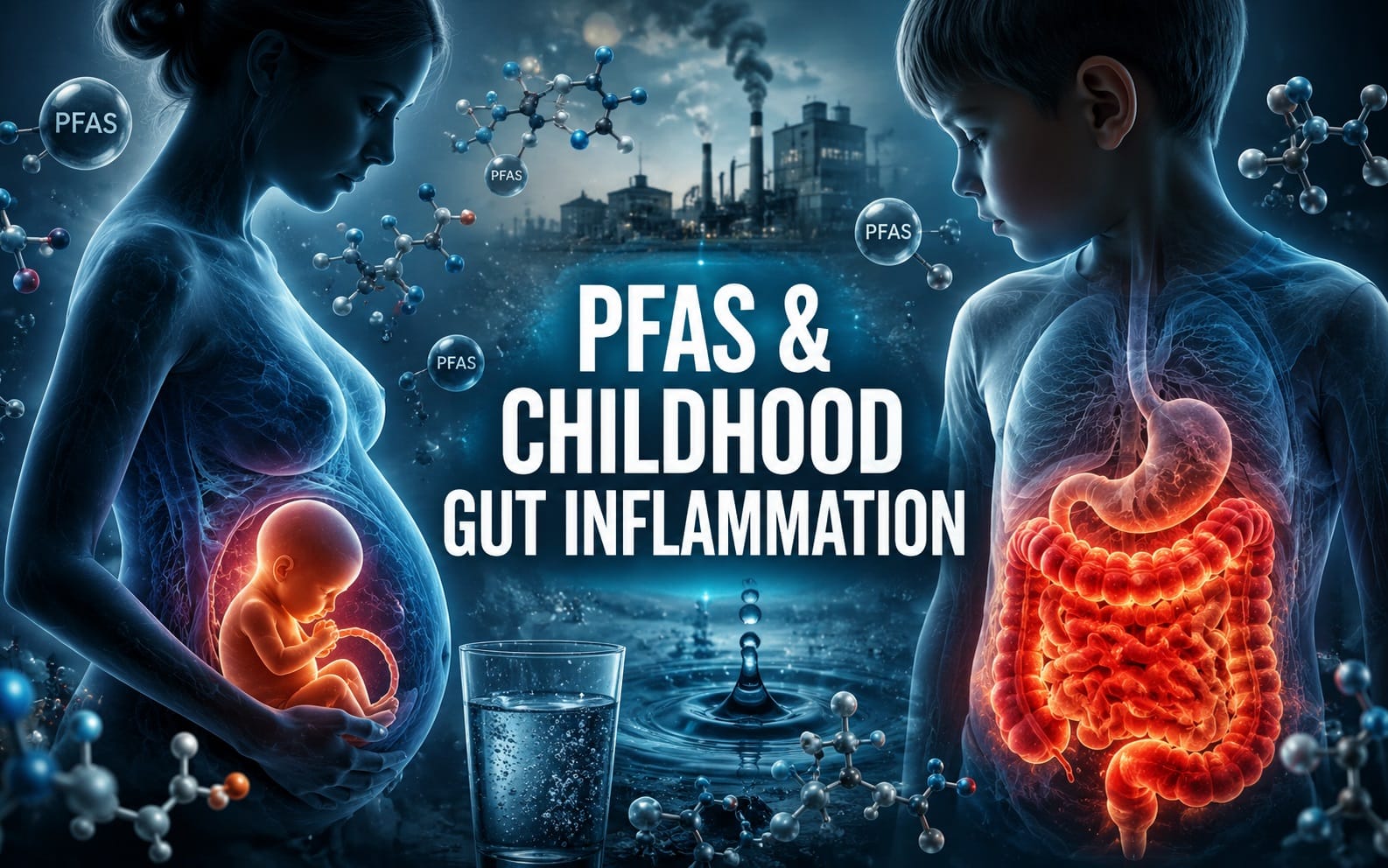
Early-life PFAS exposure may leave effects that appear years later. A Mount Sinai study found that children with higher exposure to mixtures of “forever chemicals” before or shortly after birth also had higher levels of a marker associated with intestinal inflammation. The findings show an association, not proof that PFAS directly causes disease.
Researchers at the Icahn School of Medicine at Mount Sinai have found a consistent link between early-life PFAS exposure and intestinal inflammation during childhood.
The peer-reviewed study followed 107 mother-child pairs from three birth cohorts in the United States and Mexico. Researchers measured chemical exposure during pregnancy or around birth, then examined signs of intestinal inflammation as the children grew older.
Some participants were followed for as long as 11 years.
Across the three cohorts, higher exposure to PFAS mixtures was associated with elevated fecal calprotectin, a biological marker commonly used to detect and monitor inflammation in the intestines.
The study was published on July 10, 2026, in Clinical Gastroenterology and Hepatology. Mount Sinai described it as the first study to consistently connect prenatal and early-life PFAS exposure with this marker of childhood intestinal inflammation across several independent birth cohorts.
What Did the PFAS Study Find?
The researchers analyzed PFAS exposure using biological samples collected at critical stages of development.
Those samples included:
- Maternal blood collected during pregnancy
- Umbilical cord blood
- Dried blood spots collected from newborns
Researchers later measured fecal calprotectin in the children. Higher PFAS mixture levels around the time of birth were consistently associated with higher calprotectin levels later in childhood.
Fecal calprotectin is released when certain immune cells enter the intestinal tract. Doctors often use the marker to identify inflammation and monitor conditions such as inflammatory bowel disease.
An elevated result does not prove that a child has Crohn’s disease, ulcerative colitis or another specific disorder. It also does not mean that the child will necessarily develop one.
The study instead identifies a possible biological pathway that may begin before symptoms or disease become visible.
Why Does Early-Life PFAS Exposure Matter?
Pregnancy, infancy and early childhood are periods of rapid immune and organ development. An environmental exposure during this stage may carry consequences that do not become clear until years later.
Vishal Midya, a study co-author and researcher at the Icahn School of Medicine at Mount Sinai, said the timing of the exposure made the findings especially important.
“The idea that the mom-baby dyads are exposed to these very toxic chemicals this early in the children’s’ life, and that that leads to later intestinal inflammation, is a very important finding,” Midya said. “There is so much of a knowledge gap in this area, and a gap in recognizing how important the early life period is to later onset of inflammatory bowel disease.”
Previous research has associated PFAS exposure with intestinal inflammation and inflammatory bowel disease in adults. The new study extends that concern into prenatal development and childhood.
Earlier research by members of the same Mount Sinai team also found an association between PFAS exposure and the later occurrence of inflammatory bowel disease.
What Are PFAS “Forever Chemicals”?
PFAS stands for per- and polyfluoroalkyl substances.
These synthetic chemicals have been used in consumer and industrial products because they can resist water, grease, stains and heat. They may be found in products such as nonstick cookware, food packaging, stain-resistant fabrics and firefighting foam.
PFAS are often called “forever chemicals” because many of them break down extremely slowly. They can remain in soil, water and living organisms for long periods.
This persistence creates a hidden advantage for the chemicals and a lasting problem for the public. Once released, they can move through water supplies, food systems and the environment. Repeated exposure allows certain PFAS compounds to accumulate in the human body.
Thousands of PFAS compounds have been identified. Older substances such as perfluorooctanoic acid, or PFOA, and perfluorooctane sulfonic acid, or PFOS, have received the most attention.
Although production of some older compounds has declined, replacement PFAS have entered use. Public-health information about many of these newer chemicals remains limited.
The Mount Sinai researchers reported associations involving both legacy PFAS and newer replacement compounds.
Why Did Researchers Study PFAS as Mixtures?
Much PFAS research examines one chemical at a time.
Human exposure rarely works that way.
People can encounter several PFAS compounds through drinking water, food, household dust and consumer products. The Mount Sinai team therefore analyzed the chemicals as mixtures to create a closer picture of everyday exposure.
“We’re exposed to thousands of thousands of chemicals to tease out the one or two 10 chemicals. It doesn’t mimic the real world by putting it together as a mixture,” Midya said.
Although the wording reflects the difficulty of isolating individual chemicals, the central point is clear: studying a mixture may better represent the conditions people actually face.
Mount Sinai said the consistency of the findings across different samples and three independent cohorts strengthened the evidence of a relationship between early exposure and later intestinal inflammation.
Does PFAS Exposure Cause Inflammatory Bowel Disease?
The study does not establish that PFAS directly causes intestinal inflammation or inflammatory bowel disease.
It was an observational study. That design can identify patterns and associations, but it cannot by itself prove cause and effect.
The sample size was also limited. Only 107 mother-child pairs were included across the three cohorts.
Even so, the same general association appeared across different populations and different types of early-life blood samples. That consistency gives researchers a reason to continue following the children.
The research team plans to examine whether participants with higher PFAS exposure and elevated intestinal inflammation are more likely to develop inflammatory bowel disease later in life.
How Could the Findings Affect Public-Health Decisions?
The findings shift attention toward prevention.
If environmental exposures contribute to intestinal inflammation before a child develops symptoms, reducing those exposures during pregnancy and infancy may become an important part of disease-risk research.
Manasi Agrawal, a study co-author at Mount Sinai, said understanding the early pathway could make prevention more practical.
“We are showing that there is an early life pathway to this, and understanding the disease and its origin makes the prevention part – the ‘What can we do?’ part – much more viable,” Agrawal said.
The study’s authors said the findings support broader public-health strategies designed to reduce PFAS exposure during pregnancy and early childhood.
Individual families can reduce some exposure by limiting stain-resistant treatments, waterproof products and other goods that may contain PFAS. Drinking-water testing and properly selected filtration may also help when PFAS contamination is present.
Individual choices, however, cannot remove PFAS from the wider environment. Policy, industrial controls, water treatment and contamination cleanup remain central parts of exposure reduction.
How Do Reverse Osmosis and Whole-Home Water Treatment Relate to PFAS?
Drinking water can be one source of PFAS exposure. The first step in selecting treatment is identifying what is present in the water through an appropriate laboratory test.
The U.S. Environmental Protection Agency identifies reverse osmosis, granular activated carbon and ion-exchange resin as technologies that can reduce PFAS in drinking water. The EPA also advises households to select systems independently certified for reduction of specific compounds such as PFOA and PFOS.
A reverse osmosis system is commonly installed at the kitchen sink to treat water used for drinking and cooking. It pushes water through a thin membrane that separates many contaminants from the treated water.
A standard whole-home water conditioner is designed mainly to address hardness minerals and related scale. It should not automatically be assumed to remove PFAS. Whole-home PFAS treatment generally requires specialized media, such as properly designed activated carbon or ion-exchange equipment.
System performance depends on the PFAS compounds present, contaminant levels, water chemistry, flow rate, equipment design and filter maintenance. Water testing should guide the treatment decision rather than appearance, taste or marketing claims.
What Does the PFAS Study Ultimately Show?
The Mount Sinai study shows that early-life PFAS exposure may be connected to intestinal inflammation years later.
It does not prove that exposed children will develop inflammatory bowel disease. It does not establish direct causation. It does, however, reveal a pattern across three birth cohorts during one of the most vulnerable stages of human development.
The strength of the chemicals lies in their persistence. The danger may follow the same rule.
Early-life PFAS exposure can occur briefly, while its biological consequences may remain hidden until childhood or beyond.
Source: The Guardian

 Hampton Roads VA / Northeast NC
 Jacksonville NC / Morehead City NC


