
CLIFF NOTES
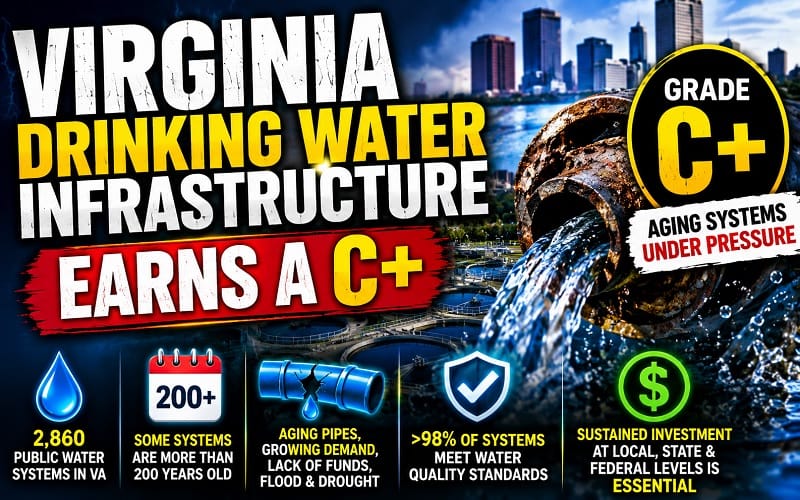
- Virginia’s drinking water infrastructure received a C+ grade from the American Society of Civil Engineers.
- Virginia has 2,860 public water systems, some of which are more than 200 years old.
- Aging pipes, population growth, demand, funding limitations, flooding, and drought contribute to infrastructure concerns.
- Newport News Waterworks says sustained local, state, and federal investment is essential.
- VDH says more than 98% of Virginia’s community water systems consistently meet water quality standards.
Virginia’s drinking water infrastructure has received a C+ grade from the American Society of Civil Engineers, while the Commonwealth’s infrastructure overall earned a C. State officials say aging pipes, population growth, rising demand, limited funding, flooding risks, and drought are putting pressure on systems that communities depend on every day.
Why Did Virginia Drinking Water Infrastructure Receive a C+?
The American Society of Civil Engineers’ infrastructure report card points to a basic problem: much of Virginia’s drinking water network is getting older while the demands placed on it continue to grow.
According to the Virginia Department of Health Office of Drinking Water, some public water systems in the Commonwealth are more than 200 years old.
Dwayne Roadcap, director of the Office of Drinking Water for the Virginia Department of Health, said the report helps show where Virginia stands and where improvements are needed.
“It highlights some of the infrastructure needs that we have specifically in drinking water. We have 2,860 public water systems in Virginia, and they all have different ages and sizes.”
Those differences matter. A small system serving one community does not face the same challenges as a large regional utility. Yet aging infrastructure affects systems across Virginia.
The reasons cited for the C+ grade include aging pipes, population growth, increasing water demand, insufficient funding to keep pace with infrastructure needs, and flooding concerns.
Virginia Has 2,860 Public Water Systems to Monitor
Virginia has 2,860 public water systems, according to Roadcap.
The Virginia Department of Health monitors how local waterworks operate. That oversight includes examining where utilities obtain their water, how the water is treated, and whether systems have reliable backup supplies.
That responsibility becomes more important when water supplies are under stress.
Roadcap said drought conditions have forced officials to consider how individual utilities would respond if their primary sources became strained.
“Where they’re getting their water, looking at, in Virginia, we’re currently in drought conditions, and so we’re looking at what are their backup water sources? How are they going to manage through drought conditions?”
The condition of pipes and treatment facilities is therefore only one part of infrastructure planning. Utilities must also prepare for changes in available water supplies and emergencies that can disrupt normal operations.
Why Aging Water Infrastructure Matters
Drinking water infrastructure operates mostly out of sight. Pipes remain underground. Treatment equipment works behind utility gates. When these systems function properly, most customers have little reason to think about them.
Age changes that equation.
Older infrastructure requires maintenance, replacement, and long-term planning. At the same time, growing populations can increase the amount of water a utility must treat and distribute.
Flooding creates another challenge. Water infrastructure must continue functioning during severe weather while utilities protect water sources and treatment systems.
Drought creates pressure from the opposite direction. Instead of too much water, utilities may have to manage declining supplies and determine whether backup sources can meet demand.
The C+ grade reflects these combined pressures rather than a single problem with Virginia’s drinking water.
How Is Virginia Paying for Water Infrastructure Improvements?
The Virginia Department of Health offers programs designed to help local waterworks improve infrastructure.
According to Roadcap, water treatment plants can use funding and loans to replace or modernize aging equipment.
But available financing does not necessarily cover the full scale of the work.
Jen Cobb, assistant director of waterworks for Newport News, said federal and local funding opportunities exist, but they do not solve the entire infrastructure problem.
“Sustained investment at not only the local level, but state and federal levels is essential.”
Her statement identifies one of the central issues behind Virginia’s C+ grade: water infrastructure requires continuous investment.
Pipes, pumps, treatment equipment, storage facilities, and other parts of a public water network have finite service lives. Maintaining those systems requires money before failures occur, not simply after equipment reaches the end of its useful life.
Does a C+ Infrastructure Grade Mean Virginia’s Water Is Unsafe?
The C+ infrastructure grade should not be confused with a finding that Virginia’s drinking water is broadly failing existing water quality requirements.
The Virginia Department of Health said more than 98% of Virginia’s community water systems consistently meet water quality standards.
That distinction is important.
An infrastructure report card evaluates the condition and needs of the systems that collect, treat, store, and deliver water. Compliance with water quality standards addresses whether utilities are meeting applicable requirements for the water they provide.
Infrastructure can therefore require major investment even while a utility continues to meet drinking water standards.
Residents who want more information about their own supply can review their local water quality report for information specific to their community.
Newport News Waterworks Points to Its Water Quality Record
Cobb said she was not surprised that Virginia’s drinking water infrastructure received a C+.
At the same time, she emphasized that infrastructure concerns do not mean Newport News is failing to provide water that meets quality requirements.
She said Newport News Waterworks exceeds standards and has received recognition at both the state and national levels.
“Newport News Waterworks is an award-winning utility. We get state and national awards, so to give a little bit of confidence in the quality of the water that we provide.”
For customers, this creates an important distinction between the present and the future.
A utility can provide water that meets standards today while still facing the long-term cost of replacing aging pipes and equipment. The report card draws attention to what must be maintained and improved so those systems remain dependable.
What Does the C+ Grade Mean for Virginia Residents?
For Virginia households, the report highlights the scale of the infrastructure behind public drinking water. Thousands of individual systems must maintain treatment equipment, distribution networks, water sources, and emergency plans.
The immediate picture is not one of widespread failure. VDH reports that more than 98% of community water systems consistently meet water quality standards.
The longer-term challenge is maintaining that performance.
Aging pipes will continue getting older. Equipment will eventually need replacement. Population growth can increase demand. Flooding and drought can place additional stress on water sources and infrastructure.
The C+ grade signals that keeping Virginia’s drinking water systems reliable will require sustained attention and investment.
What Can Home Water Treatment Address?
Public infrastructure and treatment inside a home serve different purposes.
Utilities are responsible for treating and delivering public water. Homeowners may separately use home water filtration based on the characteristics of the water reaching their property.
A whole house water conditioner treats water as it enters a home and can address specific household water concerns depending on the equipment and water conditions. A reverse osmosis system is a point-of-use treatment option designed to provide filtered drinking water, typically at the kitchen sink.
These systems do not replace investment in public infrastructure. They operate at a different point in the water supply chain.
Homeowners seeking to understand the conditions at their own property can also consider water testing before deciding whether additional household treatment is appropriate.
Virginia Drinking Water Infrastructure Faces a Long-Term Test
Virginia’s C+ drinking water infrastructure grade captures a tension that is easy to overlook.
The Commonwealth has thousands of public water systems of different ages and sizes. Some systems are more than 200 years old. Pipes and equipment require investment, while population growth, demand, flooding, and drought create additional pressure.
Yet VDH says more than 98% of Virginia’s community water systems consistently meet water quality standards.
The challenge is therefore not simply maintaining today’s performance. It is ensuring Virginia’s drinking water infrastructure has the investment, equipment, water sources, and planning necessary to continue that performance in the years ahead.
Source: 13News Now on Youtube