
CLIFF NOTES:
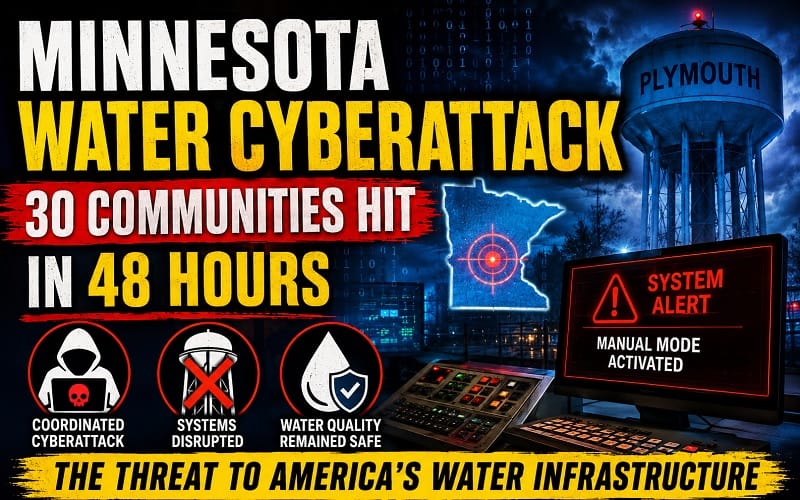
- About 30 Minnesota communities experienced cyber-related water-system disruptions over roughly 48 hours.
- Plymouth, Maple Plain, and South St. Paul used manual operations to maintain water service.
- Braham asked residents to conserve water after computerized pumping controls went offline, but the system returned in about two hours.
- Officials said water quality remained safe and had not publicly attributed the attack to a specific country or hacking group.
- The incidents demonstrate how cyberattacks can disrupt physical water infrastructure without requiring attackers to enter a treatment facility.
A coordinated Minnesota water cyberattack disrupted digital systems used by roughly 30 communities over about 48 hours, forcing several utilities to operate equipment manually. Officials said drinking water remained safe, no ransom was reported, and investigators had not publicly identified the hackers or attributed the attack to a specific country.
The episode exposed a difficult truth about modern infrastructure: the machinery that moves water through a community is physical, but many of the controls behind it are digital.
That creates a different kind of vulnerability. An attacker does not necessarily need to enter a treatment plant. If the right computer system is exposed, pumps, valves, communications equipment, and other infrastructure can potentially be disrupted from far away.
What happened during the Minnesota water cyberattack?
The trouble began Sunday night in Plymouth, Minnesota.
Water operators initially encountered unusual technology problems. Communications connected to water towers and lift stations then stopped functioning. Operators eventually determined that someone had gained unauthorized access to digital operations.
The disruption was serious enough that backup procedures were activated.
Plymouth city official Michael Thompson told local news:
“I would say the water system is safe, and we have checks and controls when an event like this comes up where we can run in manual operations just to ensure the quality and quantity of water is not affected.”
The distinction matters.
The cyberattack affected systems used to operate water infrastructure, but according to officials, it did not make Plymouth’s drinking water unsafe. Manual controls provided another way to keep essential operations functioning.
Similar problems appeared that same night in Maple Plain and South St. Paul. Operators in those communities also switched to manual systems to maintain water service.
Braham residents were asked to conserve water
By the next morning, the disruption had reached Braham.
Workers arriving at the town’s water plant found red alerts on their systems. Computerized controls responsible for pumping water from the well to the tower were offline.
The community faced a practical problem. Water was still available, but the system normally responsible for replenishing the supply was not operating as expected.
Residents were asked to reduce their water use while operators worked on the problem.
Officials said the town’s safe drinking water was not compromised. The system was restored in about two hours, and the town did not run out of water.
The episode showed why redundancy matters. When automated controls failed, local operators still had to preserve enough water for the community while restoring the system.
About 30 Minnesota communities were affected
The incidents continued over roughly 48 hours beginning Sunday evening.
In total, about 30 Minnesota communities were affected by what state officials later described as a coordinated cyberattack.
Minnesota IT Services activated its incident-response capabilities after learning about the attack. The agency said its investigation remained active while responders assessed the affected systems.
Officials described the incidents as an attack, but they did not publicly identify the responsible hackers at that stage.
The FBI also said it was aware of the incident. It did not identify a specific hacking organization or country as responsible.
That distinction is critical. Suspicion about who might have the capability to conduct an attack is not the same as official attribution.
Was Iran responsible for the Minnesota cyberattack?
The source material discusses possible foreign involvement, including Iran, but it does not establish that Iran carried out the Minnesota attacks.
At the time described, state and federal officials had not publicly attributed the incident to a particular country or hacking group.
The discussion references an Iranian-linked hacking group that had previously warned about targeting industrial control technology. Those systems include programmable logic controllers, commonly called PLCs, and supervisory control and data acquisition systems, commonly called SCADA.
Such technology is widely used to control physical equipment in industries including water, electricity, and transportation.
The earlier activity provides context for the threat facing infrastructure operators. It does not, by itself, establish responsibility for the Minnesota incident.
Why are water systems vulnerable to cyberattacks?
Modern utilities depend on a combination of physical infrastructure and computer controls.
A pump physically moves water. A valve physically controls its direction. But software, network connections, sensors, programmable controllers, and remote communications may tell that equipment when and how to operate.
That connection creates efficiency. It also creates another path into the system.
An attacker who compromises the digital controls may be able to interfere with equipment without physically entering the facility.
The Minnesota incident demonstrated the importance of maintaining manual controls and backup procedures. When digital systems failed, operators in affected communities could continue essential operations through other means.
Hackers do not always need traditional malware
Some cyberattacks are difficult to detect because attackers can use legitimate tools already installed on computer systems.
Instead of placing obvious malicious software on a network, an intruder may attempt to operate through existing administrative tools and normal system functions.
Other weaknesses can be far simpler.
Poor passwords can expose systems. Factory-default login credentials may remain unchanged. Internet-connected equipment may operate without current security updates.
For a small utility with limited staff and resources, each overlooked weakness can become another possible entry point.
Local control creates uneven cybersecurity defenses
American drinking water infrastructure is highly decentralized.
Many water systems are operated at the local level rather than through one centralized federal network. That means cybersecurity resources and practices can vary from one utility to another.
One community may have modern equipment, specialized cybersecurity staff, strong authentication, and carefully maintained backup systems. Another may depend on older technology or have fewer resources available for cybersecurity.
Attackers do not have to defeat every water system.
They need to find one that is vulnerable.
That is what makes the broader threat important. A weakness in a relatively small system can still affect the people, businesses, hospitals, schools, and emergency services that depend on its water.
Other U.S. water systems have already faced cyber incidents
The Minnesota attack was not presented as an isolated example.
The source material points to a 2023 cyberattack involving a small Pennsylvania water utility. It also references a 2024 incident at a Texas water plant that resulted in the loss of tens of thousands of gallons of water.
Another major incident occurred in 2024 when American Water, described as the largest regulated water and wastewater utility company in the United States, experienced a cyberattack.
Together, the cases illustrate why cybersecurity has become part of the larger conversation about public water systems.
Protecting water infrastructure no longer means protecting only reservoirs, wells, treatment plants, pipes, and pumping stations. It also means protecting the computers and communications systems controlling them.
What is Volt Typhoon?
The source material also discusses Volt Typhoon, a Chinese hacking group that U.S. officials have connected to targeting American infrastructure.
The concern surrounding Volt Typhoon differs from a conventional cyberattack designed to produce an immediate and visible disruption.
According to the U.S. officials described in the source, attackers associated with the group may establish access to infrastructure networks and remain there without immediately damaging anything.
That creates the possibility that compromised access could be used later.
The broader strategy makes detection especially important. A network can potentially be compromised even when pumps continue running, computers appear normal, and customers experience no interruption.
Why does the Minnesota water cyberattack matter?
The most important lesson is not that Minnesota communities lost their drinking water. According to the information provided, they did not.
The larger issue is that attackers were able to disrupt technology connected to essential physical infrastructure across numerous communities in a short period.
Water systems are particularly important because almost every other part of a community depends on them.
Homes need water. Hospitals need water. Schools and businesses need water. Fire protection depends on adequate water supplies and pressure.
A digital disruption can therefore become a physical problem if backup systems fail or operators cannot restore normal controls quickly enough.
The Minnesota communities avoided that outcome. Operators switched to manual procedures, residents in Braham were temporarily asked to conserve water, and officials reported that water quality remained safe.
But the incidents demonstrated how closely cybersecurity and drinking water safety have become connected.
Cybersecurity and water quality are different problems
A cyberattack on a utility does not automatically mean its water has become contaminated.
The Minnesota incidents involved operational technology and communications. Officials said water quality was not affected.
That distinction is important for homeowners.
Cybersecurity protects the systems that operate water infrastructure. Treatment and filtration address the physical and chemical characteristics of the water arriving at a home.
Consumers concerned about what is actually present in their water can review their local water quality report and, where appropriate, use water testing to better understand their household water.
Neither step prevents a cyberattack against a municipal utility. They address a different question: the quality of the water being delivered.
Where home water treatment fits in
Household treatment systems also should not be presented as cybersecurity protection. A home filtration system cannot keep hackers out of a municipal control network or restore a disabled community pump.
However, if the water is still flowing while municipal filtration isn’t working properly, home water filtration will benefit you greatly.
A whole house water filtration or conditioning system treats water as it enters a home. Depending on the equipment and water conditions, whole-home treatment can address specific aesthetic or treatment concerns throughout the plumbing system.
A reverse osmosis system operates closer to the point where drinking and cooking water is used. Reverse osmosis is designed to reduce a range of dissolved substances and other contaminants when the system is properly selected, installed, and maintained.
For homeowners, the practical distinction is simple: utility cybersecurity protects the infrastructure delivering water, while residential treatment addresses water after it reaches the property.
Minnesota water cyberattack shows the changing threat to infrastructure
The Minnesota water cyberattack lasted roughly 48 hours and affected about 30 communities, according to the source material. Several utilities had to move to manual operations after computerized equipment or communications failed.
Officials said drinking water remained safe. Braham restored its affected system in about two hours without exhausting its water supply. No ransom was reported, and the attack was not described as a theft of customer data.
Just as important, officials had not publicly identified the attackers or formally blamed a particular country.
That leaves the investigation separate from the larger lesson.
Modern water infrastructure depends on computers as well as concrete, steel, pumps, and pipes. Once those systems are connected, cybersecurity becomes part of protecting the water supply itself.
Source: Facts Matter on Youtube