
CLIFF NOTES
- CFPUA’s PFAS lawsuit against Chemours and DuPont remains active despite North Carolina’s major settlement.
- CFPUA spent $43 million adding eight activated carbon filters to the Sweeney Water Treatment Plant.
- The utility says Chemours and DuPont should pay contamination-related costs, not CFPUA ratepayers.
- The Cape Fear River contamination involves GenX and other PFAS chemicals linked to decades of releases from the Fayetteville Works site.
- CFPUA says 2027 is the earliest expected trial date for its ongoing federal lawsuit.
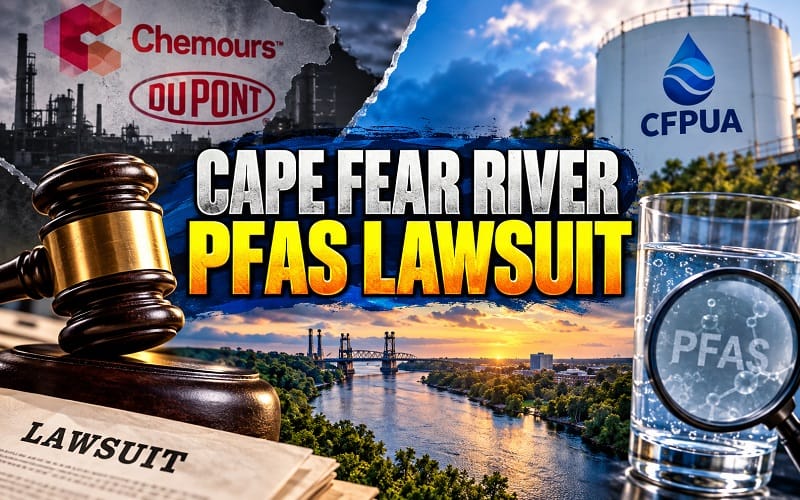
The Cape Fear Public Utility Authority says its lawsuit against Chemours and DuPont over PFAS contamination in the Cape Fear River remains active, even after North Carolina reached a major settlement with Chemours, DuPont and Corteva.
The distinction matters for Wilmington-area water customers. The new agreement settles claims involving North Carolina and 11 local entities, but CFPUA is not one of them. Its federal lawsuit, filed in 2017, continues as the utility seeks to recover millions of dollars spent responding to PFAS in its drinking water source.
What happened with the North Carolina PFAS settlement?
On September 10, 2026, North Carolina Attorney General Jeff Jackson announced a broad PFAS settlement involving the state, Chemours, DuPont, Corteva and 11 local governments and public entities.
The agreement calls for $455 million in payments over 15 years. A separate $135 million reserve is intended to help ensure Chemours meets obligations connected to PFAS cleanup and drinking-water protection. Together, state officials have valued the agreement at $590 million.
The participating local entities include Bladen, Brunswick, Columbus, Cumberland, New Hanover, Robeson and Sampson counties, along with the Town of Wrightsville Beach, City of Lumberton, Village of Bald Head Island and Lower Cape Fear Water and Sewer Authority. The settlement agreement itself identifies those governments and entities as parties.
Brunswick County, for example, announced that it will receive $95 million under the agreement, money tied in part to major investments the county made to remove PFAS from its drinking-water source.
But one important name is absent from the settlement: Cape Fear Public Utility Authority.
Why is CFPUA’s lawsuit still active?
CFPUA made its position clear shortly after the settlement was announced.
“CFPUA is encouraged to learn that Chemours has resolved its cases with the Town of Wrightsville Beach and other neighboring communities affected by PFAS pollution from Chemours and DuPont.”
The utility then emphasized the legal separation between those cases and its own:
“We want to emphasize that this settlement does not impact CFPUA’s separate and ongoing lawsuit against Chemours and DuPont.”
CFPUA said it intends to continue pursuing the companies over what it describes as decades of PFAS releases into the Cape Fear River and the resulting costs paid by the utility.
The difference is important. A large statewide settlement does not automatically end every PFAS lawsuit involving the same companies. CFPUA has its own claims, costs and litigation history.
When did CFPUA sue Chemours and DuPont?
CFPUA filed its federal lawsuit against Chemours and DuPont in October 2017 in the U.S. District Court for the Eastern District of North Carolina.
The litigation followed the discovery of GenX and other PFAS compounds in the Cape Fear River.
CFPUA attributes the contamination at issue in its lawsuit to decades of releases associated with the chemical manufacturing facility known as Fayetteville Works, located upriver from Wilmington near the Bladen-Cumberland county line. DuPont previously owned and operated the facility. Ownership and operation were transferred to Chemours as part of the company’s separation from DuPont, and Chemours has operated the site as an independent company since July 1, 2015.
That history places the dispute at the center of one of North Carolina’s longest-running battles over PFAS pollution.
How much has CFPUA spent responding to PFAS?
The lawsuit is not simply about the presence of chemicals in the river. It is also about who should bear the financial burden of treating the water.
CFPUA spent $43 million to construct eight deep-bed activated carbon filters at the Sweeney Water Treatment Plant. The plant draws its source water from the Cape Fear River and supplies drinking water to roughly 80% of CFPUA customers.
The capital cost tells only part of the story.
CFPUA reported in 2022 that it had already spent more than $49 million responding to PFAS contamination. At that time, it estimated annual operating costs for the new filters at about $3.7 million for fiscal year 2023 and approximately $5 million in subsequent years.
Those figures help explain why the lawsuit remains important even after other governments reached settlements. The argument is not merely over past pollution. It concerns the cost of infrastructure built to keep that pollution out of finished drinking water.
CFPUA’s position is that Chemours and DuPont, rather than utility customers, should pay the relevant costs and damages.
What do the Sweeney carbon filters actually do?
Granular activated carbon, commonly called GAC, is a treatment material used to adsorb certain contaminants as water passes through it.
CFPUA had already tested the technology before committing to the $43 million expansion. Earlier utility reporting said a pilot study found GAC could reduce PFAS in finished drinking water.
The full-scale filters later produced a significant result. In 2022, CFPUA reported that no PFAS, including GenX, had been detected in its most recent tests of drinking water treated at Sweeney after the new GAC filters began treating all water distributed from the plant.
That does not mean the underlying river contamination disappeared. It means the utility installed additional treatment between the contaminated source water and its customers.
This distinction is central to the lawsuit. Treatment can reduce exposure, but treatment also creates construction, maintenance, media-replacement and operating expenses.
What are PFAS and GenX?
PFAS stands for per- and polyfluoroalkyl substances, a large group of synthetic chemicals valued for properties such as resistance to heat, oil and water.
They are often called forever chemicals because many PFAS are highly persistent in the environment.
GenX chemicals are a specific type of PFAS. The U.S. Environmental Protection Agency describes GenX chemicals as replacements used in chemical and product manufacturing for PFOA.
PFAS contamination has become a national drinking-water issue because some compounds can persist in water and the environment for long periods, creating continuing questions about exposure, treatment and cleanup responsibility.
Federal PFAS rules make the Cape Fear dispute more significant
The legal battle is unfolding while federal regulation of PFAS in public drinking water continues to change.
EPA’s 2024 drinking-water regulation established enforceable Maximum Contaminant Levels of 4 parts per trillion for PFOA and 4 parts per trillion for PFOS. The agency also established limits for several additional PFAS, including GenX.
The federal picture changed again in 2026.
On May 18, EPA proposed keeping the 4-parts-per-trillion standards for PFOA and PFOS while allowing qualifying public water systems additional time — potentially until 2031 — to meet those limits. EPA separately proposed rescinding federal drinking-water regulations for PFHxS, PFNA, GenX and the PFAS Hazard Index mixture. As of September 2026, those actions remain proposed regulatory changes rather than a completed replacement of the existing framework.
That regulatory movement makes local treatment investments especially important. Utilities cannot simply wait for every legal and regulatory dispute to end before providing drinking water.
Why does the lawsuit matter to CFPUA ratepayers?
At its core, the CFPUA lawsuit asks a straightforward question: Who pays when a drinking-water utility must build expensive treatment infrastructure because contaminants entered its source water?
Without recovery from another party, treatment expenses can ultimately become part of the financial burden carried by a public utility and its customers.
CFPUA has consistently argued that its customers should not have to absorb costs resulting from the PFAS releases it attributes to Chemours and DuPont.
That is why the September settlement did not close the matter for Wilmington-area customers.
The settlement compensated other governments and entities. CFPUA’s financial claims remain separate.
When could the CFPUA PFAS lawsuit go to trial?
The case has already passed through years of legal preparation.
According to CFPUA’s litigation timeline, fact discovery occurred in December 2023. Mediation and plaintiffs’ expert reports followed in January 2024. Defendants’ expert reports were scheduled for March 2024, with expert discovery following in July 2024.
The most recent court scheduling information published by CFPUA lists 2027 as the earliest expected trial date.
A trial is therefore not necessarily imminent, and litigation can change through additional motions, court orders or settlement discussions. But as of September 2026, CFPUA publicly maintains that the case is moving forward.
The larger Cape Fear PFAS story is not finished
The September 2026 settlement is substantial. It requires $455 million in payments and establishes another $135 million reserve, bringing the total value described by state officials to $590 million. It resolves major claims involving North Carolina and 11 local entities.
But it does not settle every Cape Fear River PFAS dispute.
CFPUA’s case remains a separate test of financial responsibility for the treatment systems needed downstream.
The utility summarized that position in its September statement:
“Until then, CFPUA will continue to pursue our litigation against Chemours and DuPont for the decades of toxic PFAS releases into the Cape Fear River and the millions of dollars spent by CFPUA mitigating that contamination.”
The case now points toward 2027 as the earliest expected trial date. Until the lawsuit is resolved, the central question remains open: whether CFPUA customers or the companies accused of causing the contamination should ultimately bear those treatment costs.
What can homeowners do about PFAS in drinking water?
Public utilities and home treatment systems serve different roles. Municipal plants treat water for entire communities, while residential treatment can provide another treatment point inside a home.
For drinking water, reverse osmosis is one treatment approach used at the point of use. EPA has advised people concerned about PFAS in their drinking water to consider measures that may reduce exposure, including home or point-of-use filtration.
A properly selected reverse osmosis system can provide treatment at a kitchen drinking-water tap. Whole-home PFAS treatment can serve a different purpose by treating water as it enters the house. The appropriate technology depends on the contaminants present, treatment goals and verified performance of the equipment.
A whole house PFAS filter therefore should not be confused with the massive GAC infrastructure used by a public utility such as CFPUA. The scale is different, but the underlying principle is similar: treatment technology creates a barrier between contaminants in source water and the water people ultimately use.
For homeowners concerned about local conditions, reviewing the utility’s water quality report and obtaining appropriate water testing can help establish what is actually present before selecting treatment.
Sources:
- CFPUA — Statement confirming its lawsuit remains ongoing: This is the strongest source for the central story and includes CFPUA’s direct quotes about the September 2026 settlement.
CFPUA: Settlement with Chemours; CFPUA lawsuit ongoing - CFPUA — Original 2017 federal lawsuit summary: Documents the allegations against Chemours and DuPont, the history of PFAS releases associated with Fayetteville Works, and CFPUA’s legal claims.
CFPUA: Summary of Actions Against Chemours and DuPont - CFPUA — GAC filtration project and PFAS costs: Supports the history of CFPUA spending ratepayer money on PFAS treatment and its effort to recover costs from Chemours and DuPont.
CFPUA: GAC Filters and PFAS Treatment Costs - U.S. EPA — Current PFAS drinking-water regulations: EPA’s official page covers the federal PFAS drinking-water rule and the regulatory changes proposed in 2026.
EPA: PFAS Drinking Water Regulation - U.S. EPA — Proposed PFOA/PFOS compliance extension: This supports the article’s newer information that EPA proposed allowing qualifying water systems until 2031 to comply with the PFOA and PFOS limits.
EPA: Proposed PFOA and PFOS Compliance Extension Rule
Get A Free In-Home Test Of All Your Water Sources
Get Water Solutions
Virginia:
Virginia Beach, Norfolk, Chesapeake, Newport News, Hampton, Portsmouth, Suffolk, Williamsburg, Smithfield, Gloucester, Yorktown, Poquoson, Isle of Wight, Carrollton, Seaford, Grafton, Franklin, Emporia, Cape Charles, Courtland, Wakefield, Windsor, Naval Air Station Oceana, Naval Station Norfolk, Langley Air Force Base, Fort Eustis, Fort Monroe
North Carolina:
Raleigh, Durham, Fayetteville, Wilmington, Apex, Burlington, Wake Forest, Garner, Greenville, Jacksonville, Goldsboro, New Bern, Clayton, Kinston, Elizabeth City, Havelock, Hope Mills, Southern Pines, Pinehurst, Laurinburg, Lumberton, Henderson, Tarboro, Morehead City, Washington, Oak Island, Kill Devil Hills, Carolina Beach, Moyock, Shallotte, Williamston, Hampstead, Beaufort, Surf City, Whiteville, Newport, Ahoskie, Edenton, Swansboro, Plymouth, Emerald Isle, Kitty Hawk, Nags Head, Windsor, Sneads Ferry, Hubert, Hertford, Rocky Point, Manteo, Atlantic Beach, Camden, Castle Hayne, Bayboro, Maysville, Riegelwood, Creswell, Vanceboro, Oriental, Roper, Aulander, Rich Square, Currituck, Winton, Corolla, Camp Lejeune
 Hampton Roads VA / Northeast NC
3400 Airline Boulevard, Portsmouth VA 23701
757-966-7600
 Jacksonville NC / Morehead City NC
2582 NC-24, Newport NC 28570
252-777-5151

Wilmington NC / Leland NC
1026 Appleton Way NE #130, Leland, NC 28541
910-807-2300

Raleigh-Durham NC / Garner NC
313F Highway 70 East, Garner, NC 27529
919-238-9900