
Protector Reverse Osmosis Drinking Water System
Advanced 4-stage reverse osmosis system that reduces a wide range of contaminants and delivers exceptional tasting, clean drinking water for your family
No Prepay Penalty
$0 Down
No Prepay Penalty
$0 Down
✓ Reduces PFAS / Forever Chemicals & Microplastics by 99%
✓ Includes Dedicated Drinking Water Faucet & Tank
✓ Refrigerator Connection Available
✓ Lifetime Parts Warranty*
Reduces up to 99% of 500+ Contaminants
Includes PFAS, lead, fluoride, arsenic, nitrates & more
Better Tasting
Drinking Water
Enjoy great-tasting water for drinking, cooking & ice
Healthier Choice For Your Family & Pets
Clean, filtered water for your family and pets every day
Professional Free Installations Included
Installed by licensed experts with ongoing local service
Lifetime
Parts Warranty*
Peace of mind with the best warranty in the industry
What is the Protector Reverse Osmosis Drinking Water System?
The Protector RO is a premium 4-stage reverse osmosis system designed to remove a comprehensive range of contaminants while keeping beneficial minerals when used with the optional remineralizer.
It’s one of the most comprehensive point-of-use treatment options available for residential drinking water, providing clean, crisp, great-tasting water form a dedicated faucet.
What Contaminants Does Reverse Osmosis Help Reduce?
Reverse Osmosis has been shown to reduce many dissolved contaminants by approximately 90–99% using a 0.0001-micron membrane, including but not limited to:
- PFAS (PFOA, PFOS, GenX)
- Iron (
- Sulfur
- Lead
- Fluoride
- Pharmaceuticals
- Chlorine / Chloramine
- Arsenic
- Pesticides
- Nitrates
- Parasites
- Microplastics
- Sodium
- And More
Before You Buy RO Videos
Frequently Asked Questions
( click question to see video answer )
Will The Reverse Osmosis Be Ran To My Fridge?
Read Video Transcript / Summary
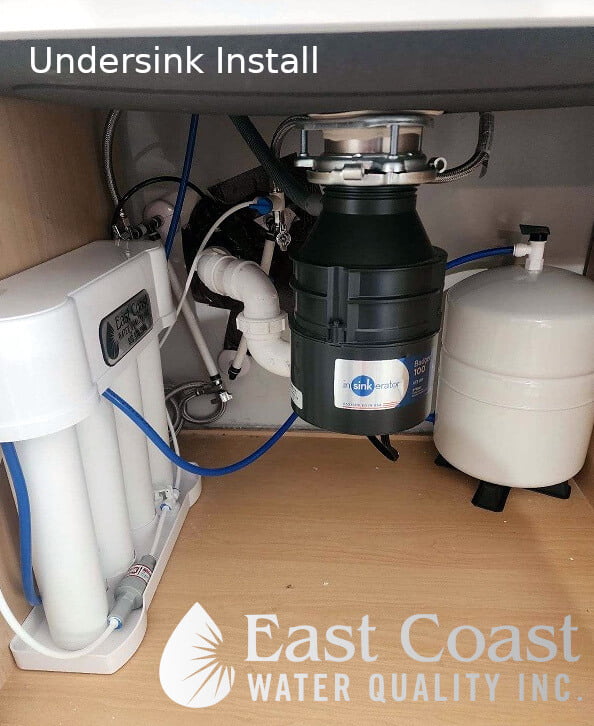
One of the most common questions we receive is whether a reverse osmosis system can supply purified drinking water directly to a refrigerator. In most crawl space homes, the answer is yes. We can typically run a reverse osmosis line from the system underneath the kitchen sink to the refrigerator with very few limitations. Reverse osmosis systems must be installed where they have access to a drain, which is why they are usually located beneath the kitchen sink.
Many homeowners also ask whether they still need the refrigerator’s factory-installed water filter. In most cases, the answer is no. Once reverse osmosis water is being supplied to the refrigerator, the refrigerator filter should be removed and replaced with a bypass plug if required by the manufacturer.
For homes built on a slab foundation, installation options depend on how the plumbing was originally configured. If cabinetry runs continuously between the sink and refrigerator, we can often route the water line through the cabinets. However, island sink layouts sometimes prevent direct refrigerator connections if a dedicated line was not installed during construction.
A single reverse osmosis system can often serve multiple drinking water locations, including additional faucets and refrigerator ice makers, depending on accessibility and distance. Most residential reverse osmosis systems produce approximately 50 gallons of purified water per day and can be expanded with larger or additional storage tanks when needed.
These systems can also be configured for specialty applications such as dedicated ice makers and saltwater aquariums, depending on water demand and installation requirements.
What You’ll Learn in This Video
- Can a reverse osmosis system supply purified water to your refrigerator and ice maker?
- Do you still need the refrigerator water filter after installing reverse osmosis?
- Installation differences between crawl space and slab homes.
- How many faucets and water locations can be supplied by one reverse osmosis system.
- Reverse osmosis storage capacity, recovery rates, and dedicated ice maker options.
- Special applications such as aquariums and multiple drinking water stations.
Drilling My Granite For The Reverse Osmosis?
Read Video Transcript / Summary
One question we receive frequently is whether homeowners need to hire someone separately to drill their granite countertop for a reverse osmosis system.
The answer is yes, we drill granite countertops as part of our reverse osmosis installations. In fact, drilling granite, quartz, and other stone countertops is something our technicians do on a regular basis.
Many homeowners are concerned about whether their specific countertop material can be drilled safely. In most cases, the answer is yes. Whether you have granite, quartz, or another common countertop surface, we can typically install the dedicated reverse osmosis faucet without any issues.
If you already have a soap dispenser installed next to the sink and would prefer to use that location for your reverse osmosis faucet, that is often an option as well. Many homeowners choose to relocate or remove the soap dispenser and use the existing hole for their drinking water faucet.
This can be especially helpful if you are planning to move in the future. Through our move program, many customers simply remove the reverse osmosis system, box it up, and take it with them to their next home. Using an existing countertop opening can make future changes even easier.
For homeowners considering a reverse osmosis drinking water system, there is typically nothing special you need to do before installation. Our team handles the countertop drilling and faucet installation as part of the process.
We have installed thousands of reverse osmosis systems over the years and routinely work with stone countertops. For most installations, drilling the countertop is a straightforward process and not something homeowners need to worry about.
If you’re considering a reverse osmosis water filtration system and have questions about your countertop, sink, or faucet location, our team can help determine the best installation option for your home.
What You’ll Learn in This Video
- Do you need to hire someone separately to drill granite for a reverse osmosis faucet?
- Can East Coast Water Quality drill granite, quartz, and other stone countertops?
- What happens if you already have a soap dispenser installed?
- How to reuse an existing countertop hole for a reverse osmosis drinking water system.
- What to do with your reverse osmosis system when moving to a new home.
- Why countertop drilling is a routine part of reverse osmosis installation.
Does Reverse Osmosis Drinking Systems Remove Lead?
Read Video Transcript / Summary
One question we get quite a bit is, “Does reverse osmosis remove lead?”
The answer is yes.
One thing to consider when you’re looking at lead reduction is why you’re concerned about lead in the first place. Many homeowners throughout North Carolina, Virginia, and across the country have been receiving notices from municipalities regarding older water infrastructure, aging service lines, and potential lead concerns. As a result, people often ask whether they should install a reverse osmosis system and what type of system makes the most sense.
One of the biggest factors to think about is the plumbing inside your home. When people talk about lead contamination, they often focus on the water line coming from the street. However, the plumbing inside the house can also play a role depending on the age of the home, fixtures, fittings, and materials that have been used over the years.
Some homeowners ask whether they should install a whole-home reverse osmosis system to address lead concerns. Whole-home reverse osmosis systems do exist, but they are a completely different application. They require significantly more space, are much more expensive, and are typically used in specialized situations.
For most homeowners, a reverse osmosis drinking water system installed at the kitchen sink is the more practical and cost-effective solution.
The reason is simple. Unless you’re planning to replace all of the plumbing in the home, the goal is usually to filter the water at the point where it is actually being consumed. That’s why reverse osmosis is commonly installed at the kitchen sink. It becomes the last point of filtration before the water enters your glass, coffee maker, cooking pot, refrigerator, or ice maker.
Rather than trying to filter every gallon of water used for showers, laundry, toilets, and outdoor watering, a reverse osmosis system focuses on producing highly purified drinking water where it matters most.
Lead is just one of the many contaminants that reverse osmosis can help reduce. Reverse osmosis systems are also commonly used to reduce fluoride, nitrates, arsenic, sodium, total dissolved solids (TDS), and many other dissolved contaminants that may be present in drinking water.
For homeowners concerned about lead, the biggest advantage of reverse osmosis is that it provides one final level of filtration immediately before consumption. By treating the water at the kitchen sink, you’re helping ensure that the water used for drinking and cooking receives the highest level of filtration available in a residential setting.
If lead is a concern in your area, it’s important to understand both your water source and the plumbing inside your home. Water testing can help determine whether lead or other contaminants are present and what treatment options make the most sense.
For many homeowners throughout North Carolina and Virginia, a reverse osmosis drinking water system remains one of the most effective and affordable ways to improve drinking water quality while reducing lead and other dissolved contaminants.
Be sure to check out our other reverse osmosis FAQs to learn about additional contaminants reverse osmosis can reduce and how these systems help provide cleaner, better-tasting drinking water for your family.
What You’ll Learn in This Video
- Does reverse osmosis remove lead from drinking water?
- Why homeowners are receiving notices about lead service lines and aging plumbing infrastructure.
- Whether you need a whole-home reverse osmosis system or a kitchen sink reverse osmosis system.
- Why point-of-use filtration is often the most practical solution for lead concerns.
- How lead can enter water through both municipal systems and household plumbing.
- Additional contaminants reverse osmosis can reduce beyond lead.
- Why many homeowners in North Carolina and Virginia choose reverse osmosis for drinking water protection.
Do I Need A Reverse Osmosis Unit If I Have The Whole Home System?
Read Video Transcript / Summary
One of the questions we get all the time is, “Do I still need a reverse osmosis system if I already have a whole-home water treatment system?” The short answer is yes, because the two systems serve very different purposes.
A whole-home system is designed to treat what we call your working water—the water you use for showers, laundry, washing dishes, and protecting your plumbing and appliances. Without getting overly technical, a water softener works through an ion exchange process. It removes hardness minerals like calcium and magnesium and replaces them with an equal amount of sodium ions. That’s great for reducing hard water problems throughout your home, but it doesn’t produce the highest quality drinking water.
That’s where reverse osmosis comes in. While the whole-home system improves water for everyday household use, the reverse osmosis system is designed specifically for drinking and cooking water. It removes many contaminants that a water softener cannot, including PFAS (“forever chemicals”), lead, arsenic, fluoride, nitrates, sodium, pharmaceuticals, microplastics, total dissolved solids (TDS), volatile organic compounds (VOCs), and many other chemical contaminants. The goal is to provide one final stage of purification right before the water reaches your glass.
If your budget doesn’t allow you to install both systems at the same time, we understand. If we had to recommend installing them in stages, we’d generally suggest starting with the reverse osmosis system because drinking water quality has the greatest direct impact on what you consume every day. That said, among our more than 8,000 customers, approximately 95% choose to install both systems because they complement each other.
Another common question is whether you still need the filter inside your refrigerator if your home already has a whole-home treatment system and reverse osmosis. In most cases, the answer is no. Refrigerator filters are typically just small carbon filters and don’t remove the broad range of contaminants that a reverse osmosis system does. In fact, the catalytic carbon used in our whole-home systems is generally much more effective than the carbon found in standard refrigerator filters.
Some refrigerators require a filter bypass plug to keep the water dispenser working after the factory filter is removed. Many refrigerators include one when they’re new, and if yours doesn’t, the manufacturer will often provide one at little or no cost. It may take a couple of attempts to receive the correct bypass plug for your specific model.
Finally, many homeowners ask whether reverse osmosis water can be supplied directly to the refrigerator and ice maker. If your home is pre-plumbed—such as many of the homes built by our builder partners—or if you have a crawl space that allows us to run a water line beneath the floor, connecting the refrigerator is usually straightforward. However, homes built on a concrete slab without a concealed route between the kitchen sink and refrigerator may not allow for a hidden water line. In those situations, you’ll still have excellent purified drinking water at the sink and can easily fill a pitcher for the refrigerator if needed.
If you have additional questions about maintenance, filter replacement schedules, or any of our water treatment systems, be sure to visit the Frequently Asked Questions section of our website or give us a call. We’re always happy to help.
What You’ll Learn in This Video
- The difference between a whole-home water treatment system and a reverse osmosis drinking water system.
- Why a whole-home system softens water but does not remove many drinking water contaminants.
- Which contaminants reverse osmosis helps reduce, including PFAS, lead, fluoride, arsenic, nitrates, pharmaceuticals, microplastics, VOCs, and total dissolved solids (TDS).
- Which system you should install first if you’re purchasing them one at a time.
- Why refrigerator water filters are not a substitute for reverse osmosis and when a filter bypass plug may be needed.
- How your home’s plumbing layout determines whether purified reverse osmosis water can be supplied directly to your refrigerator and ice maker.
Can I Add Minerals Into Drinking Water After Reverse Osmosis?
Read Video Transcript / Summary
Can we add minerals back to your water?
Absolutely, we can.
If you’ve clicked on this video, you’re probably on the reverse osmosis page. The first step is removing the contaminants you don’t want from your water before adding anything back.
If you’d like to add minerals back into your drinking water, we can install what’s called a mineralizer after the reverse osmosis system. This adds calcium and magnesium back into the water.
The mineralizer costs about $125 when added to a new reverse osmosis installation. Then, during your annual service, it adds $75 to the cost of your filter replacement and system sanitation.
The mineralizer adds approximately 60 TDS of calcium and magnesium back into the water. There’s no perfect science to that number, but it’s a good estimate after the reverse osmosis system has removed the dissolved contaminants.
I’m not saying that’s an East Coast Water Quality recommendation. If you’ve spent time on our website, you know we try to provide educational information so you can make your own decisions about topics like hydrogen water, alkaline water, and other emerging trends.
One thing that doesn’t change is the importance of pre-treatment. You always want to remove the unwanted contaminants first. Whether it’s microplastics, PFAS, or many of the other contaminants that may be present in drinking water, the goal is to remove those before deciding whether you want to add beneficial minerals back.
Hopefully this answers your question. Again, the mineralizer is approximately $125 with the original installation and $75 during the annual service when the module is replaced.
What You’ll Learn in This Video
- Whether minerals can be added back to reverse osmosis water.
- When a remineralization filter is installed.
- Which minerals are added back into the water.
- Approximately how many minerals are restored after reverse osmosis.
- The cost of adding a remineralization filter.
- Why reverse osmosis treatment should come before remineralization.
Does The Reverse Osmosis System Waste A Lot Of Water?
Read Video Transcript / Summary
Do reverse osmosis units waste a bunch of water?
That’s not really an accurate question because it depends on which reverse osmosis system you’re talking about. There are many different systems on the market, including lower-cost, do-it-yourself units.
Every reverse osmosis system produces what’s called reject water, or wastewater. As water is pushed through the reverse osmosis membrane, the clean water passes through the membrane and is stored in the bladder tank before being delivered to your faucet or refrigerator, if applicable.
The water that doesn’t pass through the membrane contains the concentrated contaminants and is sent down the drain.
Many lower-quality reverse osmosis systems can have wastewater ratios as high as 5:1, meaning they send five gallons down the drain for every gallon of purified water they produce. Better-quality systems improve that efficiency. Our reverse osmosis systems typically operate at about a 1:1 ratio, and in a worst-case scenario, about 1:2.
Keep in mind that most residential systems only have about a two-gallon storage tank, unless you’ve upgraded to a larger tank. That’s covered in another video.
One way to think about the water usage is to compare it to flushing a toilet. An average toilet flush uses about 1½ gallons of water. Let’s say your family drinks four gallons of reverse osmosis water in a day. With a 1:1 ratio, the system would also send about four gallons of wastewater down the drain. That’s roughly equivalent to two or three additional toilet flushes per day.
Personally, I don’t think that’s a significant amount of water. However, if you’re using a lower-quality reverse osmosis system with a 5:1 wastewater ratio, drinking four gallons of purified water could result in 20 gallons going down the drain. That’s a much different situation.
Another issue with some lower-cost reverse osmosis systems is the quality of their components. One of the most common failures is the automatic shutoff valve. If that valve fails, the storage tank fills, but the system never shuts off. Instead, it continuously sends water down the drain without you realizing it until you receive an unusually high water bill.
Hopefully that answers your question. It really depends on the quality of the reverse osmosis system. I wouldn’t be concerned about the wastewater produced by a high-quality reverse osmosis system. When you consider the importance of having clean drinking water, I believe it’s well worth it.
What You’ll Learn in This Video
- Whether reverse osmosis systems waste large amounts of water.
- Why wastewater ratios vary between reverse osmosis systems.
- How higher-quality reverse osmosis systems improve water efficiency.
- How much wastewater a typical family produces with a quality system.
- Why lower-cost reverse osmosis systems can waste significantly more water.
- How failed shutoff valves can lead to unexpectedly high water bills.
What Differentiates East Coast Water Quality From Competitors?
Read Video Transcript / Summary
If you’re watching this video, you’re probably wondering what sets East Coast Water Quality apart from the competition. Rather than comparing technical specifications or criticizing other companies, we’d like to explain what we believe truly matters when choosing a water treatment provider.
The first thing to consider is who will stand behind the system after it’s installed. There are countless water treatment products available online and in retail stores, but many of these companies don’t have a licensed plumbing business or local service team available when something goes wrong. While some of these systems may cost significantly less upfront, they often come with shorter warranties and aren’t designed for the same long-term reliability.
We actually install many customer-supplied systems purchased online. The challenge comes when a problem develops. While we can install the equipment, diagnosing failures, coordinating warranty claims, waiting for replacement parts, and returning to install those parts can quickly erase any initial savings. In many cases, homeowners spend more over time while still owning a product with limited support and warranty coverage.
We also believe it’s important to avoid companies that spend most of their sales presentation criticizing competitors. There are many quality water treatment products on the market, and several reputable companies offer effective solutions. Instead of focusing on what others are doing wrong, we prefer to explain how our products, pricing, and service model benefit our customers.
One important question to ask any company is whether their equipment is proprietary. Some manufacturers use exclusive parts that only their dealers can obtain. If service becomes slow or unsatisfactory, you may discover that no other company can repair your system because replacement parts aren’t available outside their network. We intentionally use industry-standard Clack control valves, along with our EcoWater partnership, so qualified water treatment professionals can service our systems if needed.
Our philosophy is based on building long-term relationships rather than making one-time sales. As licensed master plumbers, we don’t just install water treatment equipment—we also provide plumbing services, maintain existing systems, and strive to become a trusted resource for homeowners throughout the life of their home.
We also believe in transparent pricing. Rather than starting with inflated prices and negotiating them down over several hours, we offer straightforward pricing that’s consistent for every customer. While we provide discounts for groups such as military families, our pricing is fixed and designed to be fair for everyone.
Technology is another area where we believe customers should be careful. While non-electric water softeners still exist, modern electronically controlled systems offer better diagnostics, improved efficiency, easier programming, and more precise operation. That’s why we focus on proven, electronically controlled systems that provide greater reliability and performance.
Customer service is one of the areas we’re most proud of. We strive to respond to service requests within 24 hours whenever possible, and our multiple offices across Virginia and North Carolina allow us to provide local support to thousands of homeowners. If a customer ever has a concern, we encourage them to contact us directly so we can make it right.
Finally, our relationship with customers doesn’t end after installation. We return approximately 30 days after installation to perform a complimentary water retest, verify that the system is operating properly, and ensure our customers are completely satisfied. Many of the written and video testimonials on our website come directly from those follow-up visits.
Whether you’re on city water or well water, choosing the right system depends on your home’s specific needs. If you’d like more detailed information about our equipment, our Protector Series, or recommendations for your home, we’re always happy to answer your questions and help you find the right solution.
What You’ll Learn in This Video
- The key differences between East Coast Water Quality and other water treatment companies.
- Why local service, installation, and long-term support matter more than buying the cheapest system online.
- The risks of proprietary water treatment systems and why they can limit your service options.
- What to look for when comparing water treatment companies, warranties, pricing, and equipment.
- Why East Coast Water Quality uses industry-standard components that any qualified dealer can service.
- How our commitment to customer service, transparent pricing, and long-term relationships sets us apart.
Is Well Or City Water Safer In Virginia & North Carolina?
Read Video Transcript / Summary
All right, guys. This one comes up all the time. Most people think it’s a simple yes-or-no question, but it absolutely is not.
Is city water safer than well water, or is well water safer than city water?
The answer is that you’re probably going to answer this question better than I can.
With city water, there are advantages. You typically don’t have high iron or sulfur because the chlorine and other disinfectants oxidize those contaminants out of the water. However, those disinfectants are still in the water when it reaches your home. They’ve done their job, and I would encourage you to do your own unbiased research on chlorine, including evaporation, inhalation during showers, and other related topics.
Then you get into issues like dry skin and eczema. Talk to some of those customers, and they’ll tell you they don’t care what dissolved in their well water—they don’t want to deal with the way they feel from the disinfectants in city water.
On the well water side, the disadvantage is that almost anything can dissolve into it at any time. You can have arsenic, lead, bacteria, and the list goes on. Since there’s no disinfectant in private well water, if bacteria are present, you may not know it.
There’s risk with both. The honest answer is that there’s no way to have perfect water unless you treat it at the point of use. It’s not a sales gimmick. Water is the universal solvent. It wants to dissolve and carry whatever it comes into contact with.
I can’t give you a direct answer. Whether the water comes from a private well or a municipal system, we can treat both. If you’re on well water and you’re looking for the highest level of protection, and you’re not dealing with tannins, oxidized iron, or a few other difficult situations, the typical setup would be a water softener, followed by a UV light to disinfect bacteria, and then a reverse osmosis system to remove contaminants right before you drink the water. If your home has a crawl space, you can also run that reverse osmosis water to your refrigerator.
Hopefully this gives you a little bit of an answer. I’m really encouraging you to continue your research. There really isn’t a completely safe option when you consider everything that can be present in water and the potential health effects.
Another thing I didn’t touch on at the beginning is, who determines what is considered safe? If you look at EPA regulations and municipal water standards, many of those regulations for certain contaminants haven’t changed in 20, 30, or even 40 years. They establish a level that’s considered safe and another level that’s considered unsafe, but it’s worth asking how often that research is updated.
If you visit our website and go to the Water Quality Reports section, you can easily find your city’s annual water quality report without having to search through the municipality’s website. Keep in mind that these reports are often about a year and a half old. During the recording of this video in 2026, many of the available reports are from 2024 because that’s how long it takes for them to be published.
We don’t criticize cities or municipalities. They do an excellent job with the resources they have, aging infrastructure, and the challenges they face. However, no public water system is currently removing all PFAS from drinking water.
The more research you do, the more you’ll likely come to the conclusion that the only way to have confidence in your drinking water is to treat it at the point of use.
If you haven’t already, check out Dr. Frank’s PFAS in Drinking Water: Plain English series. He explains these topics in a way that’s easy to understand. There are thousands of PFAS compounds, but only a handful are currently regulated, and those regulations continue to evolve.
Check out some of our other videos if you’re interested in learning about different types of filtration or how to target a specific water quality concern. If nothing else, keep educating yourself using the resources we provide. Thank you.
What You’ll Learn in This Video
- Whether city water or well water is safer.
- The advantages and disadvantages of both city water and private well water.
- Why neither water source is completely free of contaminants.
- How point-of-use treatment can improve your drinking water quality.
- Why it’s important to review your local water quality report.
- Why ongoing water testing and treatment are important for both city and well water
Can The Reverse Osmosis Run To A Kitchen Faucet Or Pot Filler?
Read Video Transcript / Summary
Why can’t your reverse osmosis drinking system come through your main kitchen faucet? Does it have to have a separate faucet?
Unfortunately, the answer is yes. It does need to have a separate faucet.
The same concept applies to a pot filler. Can a pot filler be connected to a reverse osmosis system? Yes, but it’s going to require a booster pump. We have to increase the pressure so the pot filler has enough flow to be practical.
You also have to consider how much water you’re going to use from a pot filler. The storage tanks underneath most reverse osmosis systems only hold about two gallons of water. If you’re also supplying an ice maker, you don’t want to constantly empty that storage tank.
The same reason applies to your main kitchen faucet. The plumbing for your main faucet is much larger than the tubing used for a reverse osmosis system. The pressure provided by the reverse osmosis storage tank and the smaller water lines simply aren’t enough to properly supply a full-size kitchen faucet.
If you’re set on connecting a reverse osmosis system to a pot filler or have a custom application in mind, give us a call. We can discuss your water usage and determine whether a customized system with additional equipment, such as a booster pump, will meet your needs.
What You’ll Learn in This Video
- Why a reverse osmosis system requires its own dedicated faucet.
- Why reverse osmosis water can’t normally be connected to your main kitchen faucet.
- Why pot fillers require special considerations with reverse osmosis systems.
- How water pressure and plumbing size affect reverse osmosis performance.
- How the reverse osmosis storage tank limits water delivery.
- When a custom reverse osmosis installation may be possible.
How Much Water Does The Reverse Osmosis Make Per Day?
Read Video Transcript / Summary
How much water does a reverse osmosis unit make? Well, that depends on which system you choose. There’s really nothing we can’t customize for you.
For our standard residential reverse osmosis units, they produce 50 gallons per day. What does that mean? It doesn’t mean you’ll have 50 gallons of water available at all times. It means the system is capable of producing up to 50 gallons over a 24-hour period.
Our standard systems use a two-gallon storage tank underneath the sink unless we’ve built a custom system for you. Some customers, such as aquarium owners, need larger amounts of water for regular water changes. In those situations, we can install 4-, 6-, 8-, or even 10-gallon storage tanks. If you have a crawl space, we can often install larger tanks underneath the home and keep them out of sight. In some cases, a larger tank may require giving up additional cabinet space beneath the sink.
Keep in mind that even a two-gallon storage tank doesn’t actually hold two full gallons of water. The tank contains an internal bladder that’s pressurized to about 8 to 12 PSI, so the usable water volume is typically around 1½ to 2 gallons. That’s usually enough to supply your drinking water needs and, if applicable, your refrigerator and ice maker.
This also brings us to an important term: recovery time. While many lower-cost reverse osmosis systems advertise capacities of 15 to 20 gallons per day, that doesn’t tell the whole story. If you completely empty the storage tank, some of those systems can take four to six hours to refill. Our standard 50-gallon-per-day systems typically refill the storage tank in about one hour and 45 minutes.
That faster recovery time becomes especially important if you’re also supplying an ice maker. Lower-capacity systems often struggle to keep up with the demand, resulting in slow ice production.
For most residential applications, 50 gallons per day is the standard. However, we can also install 100-gallon-per-day systems or even much larger reverse osmosis systems, including whole-home applications, depending on your needs.
For a typical residential drinking water system, expect about 1½ to 2 gallons of stored water available at any given time, with a production capacity of up to 50 gallons per day.
What You’ll Learn in This Video
- How much water a residential reverse osmosis system produces each day.
- How much water is actually stored and ready to use.
- What “recovery time” means for a reverse osmosis system.
- How larger storage tanks can be added for higher water demands.
- Why higher-capacity reverse osmosis systems perform better than lower-capacity models.
- When a custom reverse osmosis system may be the right solution.
Bottle Water VS Reverse Osmosis Drinking Water
Read Video Transcript / Summary
Bottle water versus a reverse osmosis unit. We’re not going to give a huge scientific answer on this one.
When it comes to the advantages of both, I can’t really say there’s an advantage to bottled water over reverse osmosis water other than convenience when you’re on the go. With most of our reverse osmosis systems, we try to provide a couple of complimentary 40-ounce metal cups. We recommend sticking with metal bottles and staying away from plastics whenever possible.
That’s really the only advantage bottled water has—being able to grab it when you’re away from home if you haven’t brought enough water with you. That’s a separate topic about how much water our reverse osmosis systems produce.
The simple answer is that a reverse osmosis system filters the water right before you drink it. You’re the last person to filter your water, giving you peace of mind that it’s as clean as possible. Reverse osmosis reduces PFAS, lead, arsenic, and many other contaminants.
With bottled water, it’s hard to know exactly what standards it meets. Bottled water can come from a municipal water source, and municipal water systems are not required to remove PFAS. When you start looking at PFAS, pharmaceuticals, and many of the other contaminants that a reverse osmosis system removes, it’s really not much of a comparison.
Then there’s the cost. A reverse osmosis system will save you a significant amount of money over time. It doesn’t take long for the system to pay for itself. When you consider that a single bottle of water can cost several dollars at a convenience store, compared to filling a 40-ounce reusable bottle with clean reverse osmosis water and ice, the savings add up quickly.
Many families spend anywhere from $30 to $100 per month on bottled water. From a cost standpoint, it’s really not a close comparison.
To give you some reassurance, reverse osmosis beats bottled water in just about every category, except maybe when you’re stuck in an airport. Even then, I can probably get creative.
Hopefully that answers your question. We have plenty more videos covering topics like this, so keep checking them out.
What You’ll Learn in This Video
- How bottled water compares to reverse osmosis drinking water.
- The advantages of having a reverse osmosis system at home.
- Why reverse osmosis removes more contaminants than most bottled water.
- How reverse osmosis can save money compared to buying bottled water.
- Why reusable metal bottles are recommended over plastic bottles.
- Why reverse osmosis provides greater peace of mind for your drinking water.
How Does Losing Power Effect My Reverse Osmosis System?
Read Video Transcript / Summary
Will you have reverse osmosis water if you lose power?
The short answer is that you’ll always have whatever water is stored in your reverse osmosis storage tank at the time the power goes out.
If you’re on city water, you should generally be fine unless the city loses the backup systems that maintain water pressure. A reverse osmosis system simply needs water pressure for the system to operate.
Some reverse osmosis systems include electronic water usage monitors. If the power is out, those monitors won’t function, but as long as water pressure is available, you’ll still have access to the water that’s stored in your tank.
One additional consideration is UV sterilization systems. Some systems use a UV light to disinfect the water either before or after the reverse osmosis system. If you lose power, that UV light will no longer operate.
On city water, I don’t generally see the need for UV sterilization because the municipal water has already been disinfected with chlorine or other disinfectants. However, in certain situations—such as a vacation home where water may remain in the storage tank for extended periods—a UV system may make sense. Just remember that if the power is out, the UV light won’t be providing sterilization.
If you’re on well water, the situation is different. If you lose power, your well pump also loses power, which means you lose the water pressure needed to push water through the reverse osmosis membrane. Once you’ve used the water that’s stored in the reverse osmosis tank, you’ll be out of water until power is restored or your well pump is running again.
So, in general, a power outage doesn’t affect a reverse osmosis system on city water, provided municipal water pressure is still available. It would be very unusual for a city water system to lose pressure because most utilities have backup generators to maintain service.
One final thing to keep in mind is that our reverse osmosis systems produce up to 50 gallons per day, but with a standard two-gallon storage tank, it takes approximately one hour and 45 minutes to refill after it’s been emptied. If you’re without power, it’s a good idea to use the water in the storage tank conservatively.
Hope this helps.
What You’ll Learn in This Video
- Whether a reverse osmosis system works during a power outage.
- How the reverse osmosis storage tank provides water without electricity.
- Why city water and well water behave differently during power outages.
- How UV sterilization systems are affected by a loss of power.
- Why well water users may lose reverse osmosis water during an outage.
- How long it takes a reverse osmosis system to refill after power is restored.
If I Move Out Can I Take My Systems With Me?
Read Video Transcript / Summary
At East Coast Water Quality, we proudly serve homeowners throughout Virginia and North Carolina. One question we hear frequently—especially from military families—is what happens if you need to move shortly after purchasing one of our water treatment systems.
The good news is that your water treatment equipment can move with you. Just like any valuable investment in your home, your system can be removed and reinstalled at your next residence, allowing you to continue enjoying the same high-quality water wherever life takes you.
To help make that transition easier, we offer every customer one complimentary system removal. For most homeowners, this service is available if you move within one year of purchase. As a thank-you to our military service members, we extend that benefit to two years from the date of purchase.
During the complimentary removal, our technicians will uninstall both the whole-home system and the reverse osmosis system at no charge while restoring your home’s plumbing to its original configuration. In many cases, the opening left by the reverse osmosis faucet can be fitted with a soap dispenser for a clean, finished appearance.
Once your equipment has been removed, simply transport it with your household belongings. If you’re moving outside of our normal service area, we’ll be happy to help you locate a qualified installer in your new location to reinstall your equipment.
This relocation program is available for customers who own one of our Protector Series or EcoWater Systems products. While the initial removal service is complimentary during the eligible time period, reinstallation at your new home and installation of a soap dispenser are paid services.
Whether you’re relocating across town or across the country, our goal is to help you continue enjoying the benefits of clean, treated water in your new home.
What You’ll Learn in This Video
- What happens to your water treatment system if you move to a new home.
- How East Coast Water Quality’s free relocation program works.
- Special relocation benefits available for military families.
- Which services are included at no charge and which are paid services.
- What to do if you’re moving outside our service area.
- Which water treatment systems qualify for the relocation program.
Reverse Osmosis
vs Other Options
See how the protector RO compares to common drinking water solutions.
Move table below left and right with your finger
| Feature | Protector RO | Pitcher Filter | Refrigerator Filter | Bottled Water |
|---|---|---|---|---|
| Reverse Osmosis Membrane | Yes | No | Usually No | Varies |
| Reduces Dissolved Contaminants (PFAS, Lead, Fluoride, Arsenic) | Up to 99% | Limited | Limited | Varies |
| Removes Chlorine / Chloramine | Yes | Sometimes | Sometimes | Varies |
| Dedicated Faucet | Yes | No | No | No |
| Refrigerator Connection | Optional | No | Built-in | No |
| Professional Installation | Included | No | No | No |
| Local Service & Support | Yes | No | Limited | No |
| Ongoing Cost | Low (annual filters) | Medium (filters) | Medium (filters) | High |
| Reduces Reliance on Single-Use Bottles | Yes | No | No | No |
| Lifetime Parts Warranty* | Yes | No | Varies | No |
How the Protector RO Works - 4 Advanced Stages
Sediment
Pre-Filter

Reduces rust, silt, sediment and other particles to protect the system and prolong filter life.
Carbon Block
Pre-Filter

Reduces chlorine, chloramines, and other chemicals that can affect taste and odor.
Reverse Osmosis
Membrane

Removes up to 99% of dissolved solids at 0.0001 microns, including PFAS, lead, fluoride, arsenic, nitrates and more.
Post Carbon
Polishing Filter

Enhances taste and odor, providing exceptional tasting water at the faucet.
Professional Installation
& Annual Maintenance
Our licensed technicians install your system the right way and test it for performance. We then service the filters annually for optimal water quality. The installation is for new customers included free with purchase.


Optional Calcite Remineralizer

Add natural minerals back into your water for improved taste and pH balance. This upgrade uses colcite media to remineralize your RO water in natural, maintenance-friendly way.
✓ Adds calcium & magneseium back into your filtered Water
✓ Restores natrual alkalinity
Protector RO System Specifications
| Filtration Stages | 4 |
| Production | Up to 50 GPD |
| Membrane | High Rejection RO Membrane |
| Storage Tank | 3.2 Gallons (Standard) |
| Operating Pressure | 40-80 PSI |
| Certification | NSF/ANSI 58 |
| Dimensions | 15"H x 14"W x 5"D |
| Faucet | Match To Faucet |
| Fridge Connection | Optional |
| Filter Service | Annually |
| Warranty | Lifetime Parts* |
*For original purchaser. Labor and filters not included.
Maintenance RO Videos
Frequently Asked Questions
( click question to see video answer )
What Maintenance Do I Need To Do For My Drinking System?
Read Video Transcript / Summary
All right, you’re probably asking yourself, “What maintenance does my drinking water system need?” Maybe you recently bought a home that already has one of our systems installed. If you’re the original purchaser, you’re covered by our lifetime warranty, which includes labor, parts, and everything else—as long as the system is properly maintained.
So, what does “properly maintained” mean? The system should be serviced at least every 14 months, although we strongly recommend having it serviced every 12 months. If you’ve ever seen one of these filters cut open after a year of use, you’ll quickly understand how much they’re doing to provide your family with clean, high-quality drinking water.
If you aren’t the original purchaser, unfortunately the lifetime warranty doesn’t transfer with the home. In that case, give your local branch office a call and schedule a service appointment. They can also check their records to see when the system was last serviced. If you recently purchased the home, you may still have a few months left before service is due.
Other than the annual service, there’s really very little maintenance required for the drinking water system. However, it’s very important to have the filters replaced and the system sanitized on schedule.
As for the cost, the annual service includes filter replacement, complete system sanitation, and about one hour of labor. For 2025, and likely continuing into 2026, the total cost is approximately $288. This annual maintenance helps ensure your system continues to perform properly and keeps your drinking water as clean and safe as possible.
What You’ll Learn in This Video
- How often your reverse osmosis drinking water system should be serviced.
- Why annual filter replacement and system sanitization are essential.
- What the lifetime warranty covers for original purchasers.
- Whether the lifetime warranty transfers when you buy a home with an existing system.
- How to find out when your system was last serviced.
- What is included in the annual maintenance appointment.
- The expected annual maintenance cost and why it’s a worthwhile investment.
- How proper maintenance helps ensure consistently clean, high-quality drinking water.
Why Is Water Slower On The Reverse Osmosis System?
Read Video Transcript / Summary
If your reverse osmosis system seems to be producing water more slowly than usual, there are several things you can check before assuming something is seriously wrong. This topic can get pretty technical, so let’s stick to the most common causes.
The first thing to check is the storage, or bladder, tank located underneath your sink. Make sure it’s filling completely. If the tank is failing, it can significantly reduce the amount of water delivered to your faucet. The air pressure inside the bladder tank should typically be between 8 and 12 PSI. Keep in mind that adding too much air reduces the amount of water the tank can actually store.
Next, think about when the filters were last replaced. We recommend changing them about once a year. If your system doesn’t have a whole-home water treatment system ahead of it, sediment and hard water can clog the prefilter much more quickly. Our reverse osmosis systems typically use a 5-micron sediment filter, but untreated water with hardness above about 6 to 8 grains per gallon can shorten filter life and make it difficult to reach that one-year service interval.
If the storage tank is working properly and the filters have been replaced recently, the next possibility is the reverse osmosis membrane itself. The membrane is the heart of the system and also the most expensive filter to replace. Over time, it can become fouled or worn out, reducing the system’s ability to produce water.
There are also a few simple things you can inspect, such as making sure any shutoff valves feeding the reverse osmosis system and faucet are fully open. Installation quality can also play a role. While many plumbers install reverse osmosis systems, water filtration systems have unique requirements that aren’t always familiar to every installer. Our technicians often correct issues we find after other installations.
If you’ve checked the storage tank, verified your filters are up to date, ensured the valves are fully open, and the system is still producing water slowly, it’s probably time for a service call. Give us a call and we’ll walk you through a few additional troubleshooting steps over the phone. If necessary, we’ll schedule a visit to inspect the system and get it back to operating properly.
What You’ll Learn in This Video
- The most common reasons your reverse osmosis system may have slow water flow.
- How to check if the storage (bladder) tank is working properly.
- The correct air pressure range for a reverse osmosis storage tank.
- How clogged filters can reduce water production and pressure.
- Why replacing filters every year helps maintain system performance.
- How hard water can shorten the life of reverse osmosis filters and membranes.
- When a worn-out reverse osmosis membrane may be causing the problem.
- Simple troubleshooting steps you can safely perform before calling for service.
- Why installation quality can affect your system’s performance.
- When it’s time to schedule a professional service call
Why Is My New Reverse Osmosis System Water Cloudy?
Read Video Transcript / Summary
All right, guys. If you’re checking this Frequently Asked Questions video, you probably just had a reverse osmosis unit installed within the last 24 to 48 hours.
One of the most common questions we get is, “Why does the water look cloudy or gray when it comes out of the faucet?” A lot of times people think something is wrong with the system.
In many cases, we’re not able to pre-rinse these systems in the shop before installing them. That’s why your technician should let you know to flush at least two full bladder tanks after installation.
It typically takes about two hours for the storage tank to fill completely. Once it’s full, empty it completely. As it drains, you may hear some sputtering, and you may notice the water has a gray or cloudy appearance. That’s nothing to be concerned about.
The filters and reverse osmosis membrane are very tight, and sometimes it takes a while for them to become fully saturated and sealed. We generally recommend flushing two tanks, but we’ve seen some systems take as many as eight full tanks before the water becomes completely clear.
If you fill a glass with the water and let it sit for a minute, you’ll usually see the cloudy appearance disappear as the tiny air bubbles rise to the top. During the winter, some systems are also shipped with a protective solution to help prevent freezing, which is another reason flushing the system is important.
Give the system another tank or two to flush, and keep an eye on the water. Watch the stream coming from the faucet and observe whether the cloudiness clears in the glass. We wouldn’t be concerned if it’s still happening after six or seven tanks, although sometimes it clears after just one.
If the water is still cloudy after about six full tanks, give us a call. We’ll come out within 24 hours to take another look. In most cases, we’ll simply flush the system again, because that’s almost always the cause of the cloudy appearance.
Have a good day.
What You’ll Learn in This Video
- Why newly installed reverse osmosis water may look cloudy or gray.
- Why it’s important to flush the system after installation.
- How long it typically takes for the storage tank to refill.
- How to tell the difference between harmless air bubbles and an actual water quality issue.
- When cloudy water is normal and when you should call for service.
- What to expect if your reverse osmosis system still appears cloudy after several flushes.
What Our Customers Say
Posted on Google
 Aeryn PJuly 21, 2026
Trustindex verifies that the original source of the review is Google.
We have had a wonderful experience with East Coast Water Quality. Mr. Joel Newcomb came to our house for an in-home water test and was very professional and knowledgeable. He was extremely helpful in identifying issues with our water and helping us get the installation scheduled. The installation tech who came was also very knowledgeable and made sure to walk me through everything I needed to know about our new system.Posted on Google Brittany BMay 19, 2026Our hard water that was causing skin issues for the whole family. The system installation was fast and and the reps were super helpful answering any questions we had. We noticed a difference immediately and now our kids skin conditions have improved.Posted on Google
 Kathy DMay 19, 2026Ryan did a great job installing and cleaning up. He’s very polite and efficient about his work. He’s really nice young man!Posted on Google
 Sam RApril 26, 2026Great company to work with and no pressure.Posted on Google
 Alicia VApril 26, 2026Very happy with East Coast Water Quality from start to finish. Mike was very knowledgeable and explained everything while testing the water. Installation was painless.Posted on Google
 Denzel WFebruary 27, 2026Eastern Coastal Water Quality provided outstanding service from start to finish. Their team was professional, knowledgeable, and took the time to clearly explain the entire process. Communication was consistent, and they made everything simple and stress-free. You can tell they genuinely care about the quality of their work and their customers. I highly recommend Eastern Coastal Water Quality to anyone looking for reliable and trustworthy service.Posted on Google
 James AJanuary 15, 2026First class customer service! Chris, the owner, gave us a full on explanation of the systems available for our water issues and helped us to choose the best system to mitigate them. The price was easily the best we had been quoted from other services we inquired with and we didn't walk away feeling like we had just dealt with a "used car salesman". The installation was scheduled within a couple of days and the plumber, Ryan even showed up almost an hour early. He went right to work and a few hours later we were up and running. He took the time to fully explain the operations of the system and the maintenance required which was minimal. He cleaned up his work and left it as if he had never been here. Anyone looking for an affordable solution to your town, county, or well water problems, we highly recommend East Coast Water Solutions.Posted on Google
 Monica BOctober 24, 2025Highly recommend this company! We were tired of having to refill our water purifier everyday, and decided to get a reverse osmosis drinking system installed in our home. After filling out the online form, I was promptly contacted the next morning. Chris, the owner, clearly explained all the options and answered all of my questions. The informational collateral he shared was well-made and made everything easy to understand. When we decided to move forward, they were able to get us in right away! Ryan, our tech, arrived exactly when they said he would and he was so professional, courteous and knowledgeable, explaining everything about the system and walking me through the installation process. Overall, I had the best experience with East Coast Water Quality and would recommend them to anyone looking to improve the water quality in their home.
Serving Virginia & North Carolina
Professional Reverse Osmosis system installation and service in:
Get A Free In-Home Test Of All Your Water Sources
Get Water Solutions
Virginia:
Virginia Beach, Norfolk, Chesapeake, Newport News, Hampton, Portsmouth, Suffolk, Williamsburg, Smithfield, Gloucester, Yorktown, Poquoson, Isle of Wight, Carrollton, Seaford, Grafton, Franklin, Emporia, Cape Charles, Courtland, Wakefield, Windsor, Naval Air Station Oceana, Naval Station Norfolk, Langley Air Force Base, Fort Eustis, Fort Monroe
North Carolina:
Raleigh, Durham, Fayetteville, Wilmington, Apex, Burlington, Wake Forest, Garner, Greenville, Jacksonville, Goldsboro, New Bern, Clayton, Kinston, Elizabeth City, Havelock, Hope Mills, Southern Pines, Pinehurst, Laurinburg, Lumberton, Henderson, Tarboro, Morehead City, Washington, Oak Island, Kill Devil Hills, Carolina Beach, Moyock, Shallotte, Williamston, Hampstead, Beaufort, Surf City, Whiteville, Newport, Ahoskie, Edenton, Swansboro, Plymouth, Emerald Isle, Kitty Hawk, Nags Head, Windsor, Sneads Ferry, Hubert, Hertford, Rocky Point, Manteo, Atlantic Beach, Camden, Castle Hayne, Bayboro, Maysville, Riegelwood, Creswell, Vanceboro, Oriental, Roper, Aulander, Rich Square, Currituck, Winton, Corolla, Camp Lejeune
 Hampton Roads VA / Northeast NC
3400 Airline Boulevard, Portsmouth VA 23701
757-966-7600
 Jacksonville NC / Morehead City NC
2582 NC-24, Newport NC 28570
252-777-5151

Wilmington NC / Leland NC
1026 Appleton Way NE #130, Leland, NC 28541
910-807-2300

Raleigh-Durham NC / Garner NC
313F Highway 70 East, Garner, NC 27529
919-238-9900