CLIFF NOTES:
- A 30-inch sewer force main broke in Portsmouth on Aug. 4.
- The failure released an estimated 3.15 million gallons of sewage and wastewater.
- A recreational water advisory for Hull Creek was issued Aug. 5 and later lifted.
- A second crack required an additional repair clamp on Aug. 11.
- Virginia health officials reported no evidence that the spill affected drinking water.
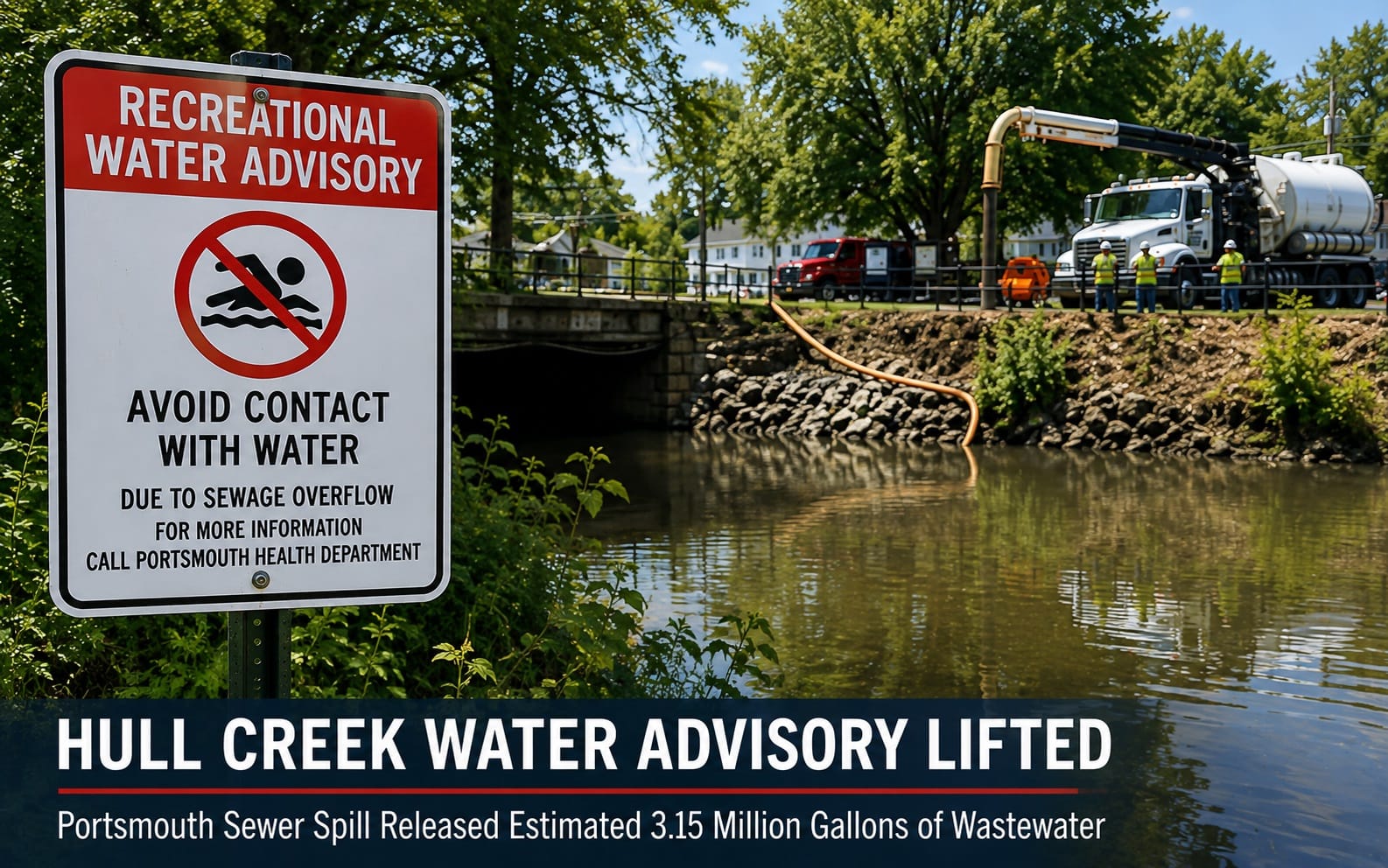
Virginia health officials have lifted the recreational water advisory for Hull Creek in Portsmouth after a sewer force main failure released an estimated 3.15 million gallons of wastewater. Officials reported no evidence that the spill affected drinking water, while cleanup and repair work continued for days after the initial break.
What happened in the Portsmouth sewage spill?
The incident began Aug. 4 when a 30-inch sewer force main broke on Douglas Avenue near Rolfe Terrace in Portsmouth.
The failure sent an estimated 3.15 million gallons of sewage and wastewater into surrounding streets and the Hull Creek area. The Virginia Department of Health issued a recreational water advisory for Hull Creek on Aug. 5 because of the potential health risks associated with contact with sewage-contaminated water.
Hampton Roads Sanitation District crews stopped the major overflow and carried out emergency repair work. One source reported emergency repairs were completed on the day of the break, while the second reported that HRSD crews completed repairs Aug. 7. The two accounts therefore differ on the precise completion date of the initial repair work.
Cleanup continued after the overflow stopped. Crews used vacuum trucks to recover approximately 5,000 gallons of wastewater and removed grit and debris washed out of the damaged sewer main.
A second crack required another repair
The initial failure was not the final problem crews found.
A second crack was later discovered in a concrete pipe connected to the replacement sewer line. According to the Virginia Department of Environmental Quality, HRSD installed a repair clamp on Aug. 11 to stop the slow leak.
Wastewater service to Portsmouth utility customers remained uninterrupted during the repair process.
The sequence shows why a major sewer failure can require work beyond stopping the first visible overflow. Crews had to address the damaged infrastructure, recover wastewater, remove debris and deal with the additional leak.
Why was the Hull Creek water advisory lifted?
The Portsmouth Health Department announced that the recreational water advisory had been lifted after the spill and subsequent response.
The most important distinction for residents is between recreational water and the public drinking-water supply.
The advisory concerned recreational contact with Hull Creek. Health officials said they found no evidence that the sewage spill affected drinking water.
That distinction matters because a sewage release into a creek or other surface water does not automatically mean the water coming from household taps has been contaminated. Public drinking water safety depends on the condition and operation of the drinking-water system, while the Hull Creek advisory addressed possible exposure to wastewater in the affected recreational water.
What should people avoid after a sewage spill?
Even after an advisory is lifted, health officials recommend paying attention to visible and noticeable signs that water may be unsafe.
The health department advised people to avoid water that:
- Has a foul odor.
- Appears discolored.
- Contains dead or dying fish.
People should also follow posted advisory signs when restrictions are in effect.
Anyone who cannot avoid contact with potentially affected water should promptly wash exposed skin with soap and water. Clothing, fishing equipment, life vests, ropes, paddles and other items that contact the water should also be rinsed or washed.
Anyone who develops adverse health effects after exposure should seek medical care and tell the medical provider about the waterbody exposure.
These precautions are intended to reduce the risk of recreational water illnesses following sewage spills and other forms of water pollution.
What should anglers know?
Health officials also provided precautions for people harvesting fish from affected waters.
Fish should have the skin and organs discarded, and the remaining meat should be cooked to the proper temperature. Cutting boards, knives and other implements used during preparation should be cleaned with warm, soapy water.
The recommendations are meant to reduce possible exposure after a sewage spill rather than establish that every fish in the area is contaminated.
Did the Portsmouth sewage spill contaminate drinking water?
According to the Virginia Department of Health, there was no evidence of a remaining impact on drinking water associated with the Hull Creek incident.
The second account similarly states that the health department observed no evidence that the spill affected drinking water.
That is the central point for Portsmouth residents concerned about tap water quality: the recreational advisory resulted from wastewater entering the environment, but health officials did not report evidence that the public drinking-water supply had been contaminated.
Residents evaluating their household water can also distinguish between an emergency spill advisory and routine water testing. An advisory provides public-health guidance about a known incident, while testing or a local water report provides information about the water being evaluated.
Why does the Hull Creek sewage spill matter?
The size of the release makes the event significant. Approximately 3.15 million gallons of wastewater escaped after the 30-inch force main failed.
The spill prompted a recreational water advisory, cleanup operations, infrastructure repairs and continued monitoring. A second crack discovered after the initial failure also required an additional repair on Aug. 11.
For the public, the event demonstrates that different parts of the water system carry different risks. A wastewater spill can create immediate concerns for streams, creeks and recreational waters without necessarily contaminating the treated tap water supplied to homes.
Health officials ultimately lifted the Hull Creek advisory and reported no evidence of an impact on drinking water.
How do home water filtration systems relate to incidents like this?
A home treatment system should not be treated as a substitute for official public-health instructions during a sewage emergency. Residents should follow notices from health departments and water utilities whenever authorities issue drinking-water restrictions or boil-water advisories.
For routine household water treatment, a reverse osmosis system is a point-of-use treatment option designed for drinking water, while whole house water filtration addresses water throughout a home. The appropriate treatment depends on the specific water conditions and contaminants being addressed.
In the Hull Creek sewage spill, however, Virginia health officials reported no evidence that drinking water was affected. The lifting of the recreational advisory therefore marks the end of restrictions associated with contact with Hull Creek, not the resolution of a reported contamination problem within Portsmouth’s drinking-water supply.Source:
Virginia Pilot
 Hampton Roads VA / Northeast NC
 Jacksonville NC / Morehead City NC


