
Well Water Treatment in Hampton, VA
Private wells can have very different water chemistry from one Hampton property to the next. East Coast Water Quality evaluates the actual well before recommending treatment for iron staining, sulfur odor, hardness, acidity, tannins, sediment or other identified conditions.
If a Hampton Well Has Iron or Sulfur, Which System Treats It?
When testing confirms iron or hydrogen sulfide, the Protector Iron / Sulfur Breaker is ECWQ’s primary treatment system. It oxidizes and filters those contaminants before the water reaches downstream conditioning equipment, plumbing and fixtures.
- Removes dissolved ferrous iron.
- Removes oxidized ferric iron.
- Eliminates hydrogen-sulfide sulfur gas and odor.
- Reduces rust staining on fixtures and laundry.
- Uses no salt or added treatment chemicals.
- Protects downstream conditioners, filters and appliances.
The Iron / Sulfur Breaker comes first
When iron or sulfur is present, it should normally be treated before a water conditioner. Removing iron first protects the conditioner resin and carbon from fouling.

What Different Well-Water Symptoms Can Point To
Private-well conditions can vary from one property to the next. Testing helps distinguish iron, sulfur, hardness, low pH, tannins, sediment and other possible causes.
Ferrous Iron, Ferric Iron and Hydrogen Sulfide
The form of the contaminant affects what you see at the tap and how the treatment system must work.
Ferrous Iron
Dissolved iron can look clear when water first leaves the faucet, then turn orange or rusty after exposure to oxygen.
Ferric Iron
Oxidized iron appears as visible rust-colored particles, cloudy orange water or sediment that settles in a container.
Hydrogen Sulfide
Hydrogen sulfide causes the familiar rotten-egg odor and can affect taste, plumbing and overall water usability.
How the Protector Iron / Sulfur Breaker Works
The system converts dissolved contaminants into filterable particles, captures them in the media bed and cleans itself automatically.
Well Water Enters
Untreated water enters the system before reaching the conditioner, plumbing or fixtures.
Iron and Sulfur Oxidize
Dissolved iron and hydrogen sulfide are converted into forms that can be filtered.
Media Captures Contaminants
Oxidized iron particles and sulfur compounds are trapped before water enters the home.
Automatic Backwashing
The system periodically cleans the media bed and flushes captured material to the drain.
No salt is used by the Iron / Sulfur Breaker
The oxidation system does not need a brine tank. Salt is only required when a separate ion-exchange water conditioner is installed for hardness.
Well Water Treatment Systems Selected From the Results at Your Hampton Home
The Iron / Sulfur Breaker is used when iron or hydrogen sulfide is confirmed. A Protector whole-home conditioner may be added after it when testing also shows hardness or when the household has an appropriate whole-home conditioning goal.
Primary Well-Water SystemProtector Iron / Sulfur Breaker
Salt-free oxidation and filtration for iron, sulfur odor and rust-related well-water problems.
- Removes ferrous iron
- Removes ferric iron
- Eliminates hydrogen sulfide
- Reduces orange and brown staining
- Improves clarity and aesthetic quality
- Protects pumps, valves and appliances
- Suitable for irrigation applications
- Ideal pretreatment before a conditioner
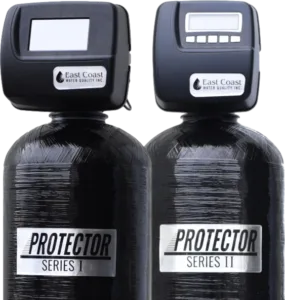 Secondary Treatment
Protector Whole-Home Conditioner
Installed after iron and sulfur treatment when the well also has hardness, mineral scale or household comfort concerns.
- Ion-exchange hardness treatment
- Reduces scale and spotting
- Helps protect appliances and plumbing
- Improves soap and detergent performance
- Includes coconut and catalytic carbon
- Requires salt for regeneration
- Should be protected from iron fouling
When Both Systems Are Needed, Why Iron / Sulfur Treatment Goes First
Iron can coat softening resin, carbon and internal valve parts. Pretreating iron and sulfur first helps the downstream conditioner operate more effectively and last longer.
Step 1: Iron / Sulfur Breaker
Oxidizes and captures ferrous iron, ferric iron and hydrogen sulfide before they can foul other equipment.
- Salt-free operation
- Rust and odor treatment
- Automatic backwashing
- Protects downstream systems
Step 2: Whole-Home Conditioner
Softens the pretreated water when calcium, magnesium, scale or household comfort concerns are also present.
- Hardness treatment
- Scale and spotting reduction
- Carbon filtration
- Softer-feeling water
Not every well needs both systems.
A well with iron and sulfur but little hardness may only need the Iron / Sulfur Breaker. A well with hardness but no significant iron or sulfur may only need a conditioner. Testing determines the correct configuration.
Which System Treats Which Well-Water Problem?
| Well-Water Problem | Iron / Sulfur Breaker | Whole-Home Conditioner | Specialized Treatment |
|---|---|---|---|
| Ferrous iron | Primary treatment | Not preferred as primary treatment | Testing determines loading |
| Ferric iron | Primary treatment | Can foul resin and valve | Sediment pretreatment may be considered |
| Hydrogen sulfide odor | Primary treatment | Not the primary purpose | Source investigation may be needed |
| Rust staining | Primary treatment | Secondary only after iron removal | Check plumbing and fixtures |
| Hardness and white scale | Not the primary purpose | Primary treatment | Test calcium and magnesium |
| Water spots and poor soap lather | Not the primary purpose | Primary treatment | Confirm hardness |
| Low pH / acidic water | Not the primary purpose | Not the primary purpose | Acid neutralizer |
| Tannins / tea-colored water | Not automatically addressed | Not standard softening treatment | Tannin-specific media |
| Bacteria | Not disinfection | Not disinfection | Laboratory test and disinfection system |
| Arsenic, nitrate or PFAS | Not the primary purpose | Not the primary purpose | Lab testing and contaminant-specific treatment |
How East Coast Water Quality Builds a Well-Water Treatment System
A successful well-water installation begins with the water chemistry, flow rate and plumbing—not with choosing equipment from a generic list.
- Evaluate the water problem.
We review staining, odor, taste, sediment, hardness and other household symptoms. - Test the relevant water characteristics.
Iron, sulfur, hardness, pH and other parameters guide treatment selection. - Measure flow and inspect the plumbing.
The equipment must match the well pump, pressure tank and household demand. - Place systems in the correct order.
Iron and sulfur treatment is installed ahead of a conditioner when both are required. - Program and backwash the equipment.
Controls are configured for the water conditions and household use. - Review operation and maintenance.
The homeowner receives instructions for normal operation, salt and service.
What Should Be Checked Before Treating a Hampton Private Well?
The right test depends on the symptom, well history and treatment goal. ECWQ can evaluate common aesthetic and equipment-sizing conditions, while bacteria, nitrate, arsenic, PFAS and other health-related contaminants require appropriate laboratory analysis.
Iron and Manganese
Helps identify staining, sediment and the treatment loading placed on oxidation equipment.
Hydrogen Sulfide
Evaluates rotten-egg odor and helps determine whether the source is the well, plumbing or water heater.
pH and Acidity
Low-pH water may corrode plumbing and require neutralization separate from iron treatment.
Hardness
Determines whether a conditioner should be installed after the Iron / Sulfur Breaker.
Bacteria
Total coliform and E. coli require proper sample collection and laboratory analysis.
Nitrate and Arsenic
These contaminants cannot be diagnosed by taste, odor or the standard free home evaluation.
PFAS
PFAS analysis requires specialized laboratory collection and testing procedures.
Tannins and Color
Tea-colored water may require treatment media that is different from iron or hardness equipment.
The in-home water evaluation is not an extensive laboratory test.
During the in-home evaluation, the technician can test common household water conditions and make treatment recommendations from the findings. Bacteria, arsenic, nitrate, PFAS and other health-related contaminants require appropriate laboratory analysis.
Maintaining Iron, Sulfur and Conditioning Equipment
Inspect Oxidation Performance
Annual service helps verify the control valve, oxidation process, backwash cycle and media condition.
Maintain the Conditioner
When a conditioner is installed, keep the brine tank supplied with the recommended water-softener salt.
Prevent Freezing
Equipment in sheds, pump houses or unconditioned spaces must be protected during prolonged freezing weather.
Hampton Well Water Treatment FAQs
What system removes iron from well water?
The Protector Iron / Sulfur Breaker is the primary system for dissolved ferrous iron and oxidized ferric iron. Treatment should be sized from actual testing and household flow.
What removes rotten-egg odor from well water?
Rotten-egg odor is commonly associated with hydrogen sulfide. The Iron / Sulfur Breaker uses oxidation and filtration to eliminate sulfur gas and odor.
Does the Iron / Sulfur Breaker use salt?
No. The Iron / Sulfur Breaker itself does not use salt. A separate water conditioner uses salt when hardness treatment is also required.
What is the difference between ferrous and ferric iron?
Ferrous iron is dissolved and may look clear at first. Ferric iron is oxidized and appears as visible rust-colored particles, cloudy water or sediment.
Why does clear water turn orange after sitting?
Dissolved ferrous iron can oxidize after exposure to air and become visible ferric iron, creating orange color and staining.
Will a water softener remove iron?
A softener may handle limited dissolved iron under suitable conditions, but significant iron can foul resin and valves. The Iron / Sulfur Breaker is the preferred primary treatment for iron and sulfur problems.
Why install the Iron / Sulfur Breaker before the conditioner?
Pretreating iron and sulfur protects the downstream softening resin, carbon and valve components from fouling.
Do I need both systems?
Only when testing shows both iron or sulfur and hardness-related concerns. Not every well requires both systems.
Does the conditioner remove sulfur odor?
A standard conditioner is not the primary sulfur treatment. Hydrogen sulfide should be treated with an appropriate oxidation system.
Can the Iron / Sulfur Breaker treat irrigation water?
The system is suitable for irrigation applications when it is properly sized for the required flow.
Does the system add chemicals to the water?
The Iron / Sulfur Breaker is an oxidation system that does not require salt or routine chemical feed.
Will it remove bacteria, arsenic, nitrate or PFAS?
Those are not the primary purposes of the Iron / Sulfur Breaker or conditioner. They require appropriate laboratory testing and contaminant-specific treatment.
What causes blue-green stains in well-water homes?
Blue-green stains can indicate copper corrosion associated with acidic water. A pH test is needed, and an acid-neutralizing system may be required.
How often should well-water equipment be serviced?
Annual professional inspection is recommended to review control-valve operation, backwashing, settings, salt use and overall system performance.
Does the free water test include bacteria or PFAS testing?
No. The in-home evaluation is not certified bacteria, PFAS, arsenic, nitrate or extensive laboratory testing. Those contaminants require appropriate laboratory analysis.
Continue With the Hampton Water Page That Matches Your Goal
Water Problems
Compare iron, sulfur, hardness, PFAS and other contaminants with treatment options.
View water problems →Water Conditioners
Explore secondary whole-home treatment for hardness, scale and household comfort.
Explore conditioners →Reverse Osmosis
Add highly filtered drinking water after whole-home well-water treatment.
Explore reverse osmosis →PFAS Filters
Compare targeted PFAS and lead filtration with contaminant-specific well treatment.
Explore PFAS filters →Municipal Water Report
Read Hampton's Lower Peninsula public-water report while keeping private-well results separate.
View the report →Free Water Test
Schedule a local evaluation for common well-water symptoms and treatment planning.
Schedule an evaluation →Get the Right Treatment Plan for Your Hampton Private Well
Schedule a well-water evaluation and discuss the actual symptoms, water characteristics, flow requirements and treatment order for your property before choosing equipment.
Virginia:
Virginia Beach, Norfolk, Chesapeake, Newport News, Hampton, Portsmouth, Suffolk, Williamsburg, Smithfield, Gloucester, Yorktown, Poquoson, Isle of Wight, Carrollton, Seaford, Grafton, Franklin, Emporia, Cape Charles, Courtland, Wakefield, Windsor, Naval Air Station Oceana, Naval Station Norfolk, Langley Air Force Base, Fort Eustis, Fort Monroe
North Carolina:
Raleigh, Durham, Fayetteville, Wilmington, Apex, Burlington, Wake Forest, Garner, Greenville, Jacksonville, Goldsboro, New Bern, Clayton, Kinston, Elizabeth City, Havelock, Hope Mills, Southern Pines, Pinehurst, Laurinburg, Lumberton, Henderson, Tarboro, Morehead City, Washington, Oak Island, Kill Devil Hills, Carolina Beach, Moyock, Shallotte, Williamston, Hampstead, Beaufort, Surf City, Whiteville, Newport, Ahoskie, Edenton, Swansboro, Plymouth, Emerald Isle, Kitty Hawk, Nags Head, Windsor, Sneads Ferry, Hubert, Hertford, Rocky Point, Manteo, Atlantic Beach, Camden, Castle Hayne, Bayboro, Maysville, Riegelwood, Creswell, Vanceboro, Oriental, Roper, Aulander, Rich Square, Currituck, Winton, Corolla, Camp Lejeune
 Hampton Roads VA / Northeast NC
3400 Airline Boulevard, Portsmouth VA 23701
757-966-7600
 Jacksonville NC / Morehead City NC
2582 NC-24, Newport NC 28570
252-777-5151

Wilmington NC / Leland NC
1026 Appleton Way NE #130, Leland, NC 28541
910-807-2300

Raleigh-Durham NC / Garner NC
313F Highway 70 East, Garner, NC 27529
919-238-9900