
Cliff Notes
- GENX: The Saga of Forever Chemicals premiered in Saxapahaw on November 13, 2026.
- North Carolina’s 2017 investigation linked GenX contamination in the Cape Fear River to the Chemours Fayetteville Works facility
- A 2019 consent order required pollution controls, private well testing, and replacement drinking water for qualifying households.
- New Saxapahaw testing in 2026 found PFOA and PFOS above federal limits at six sampled locations.
- EPA guidance identifies certified carbon filtration, ion exchange, and reverse osmosis as treatment methods that can reduce certain PFAS.
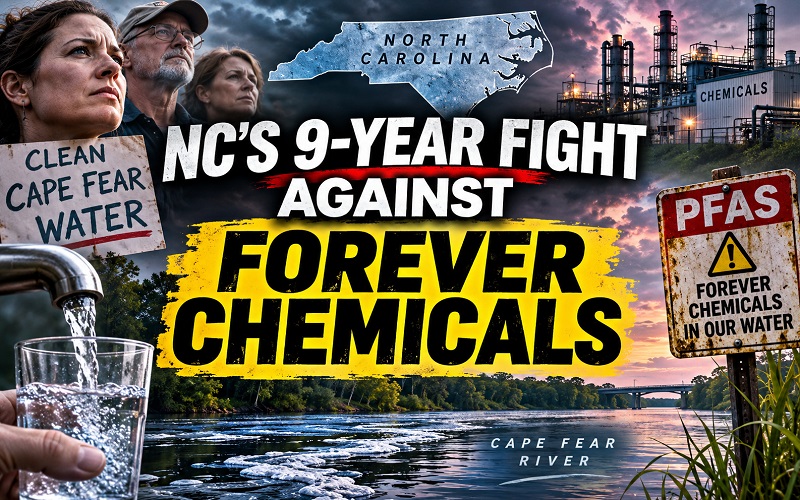
A new documentary, GENX: The Saga of Forever Chemicals, examines nine years of PFAS contamination investigations in North Carolina’s Cape Fear River region. The film follows affected families, environmental advocates, scientists, and legal efforts to address industrial pollution. Its November 13, 2026, premiere came as new testing revealed additional drinking water concerns in Saxapahaw.
For communities along the Cape Fear River, the discovery of PFAS contamination in 2017 marked the beginning of a long struggle over drinking water safety, industrial responsibility, and public health.
Nearly a decade later, many of those questions remain unresolved.
Directed by Eli Yetter-Bowman and Sammy Bauer of Ethereal Films, GENX: The Saga of Forever Chemicals examines how industrial chemicals entered North Carolina’s environment, how residents discovered the contamination, and what has changed since the problem became public.
The documentary premiered November 13, 2026, at the Haw River Ballroom in Saxapahaw, North Carolina. It features environmental attorney Robert Bilott, actor and environmental advocate Mark Ruffalo, and North Carolina Gov. Josh Stein.
The film connects a regional environmental crisis with a much larger national issue: the presence of persistent industrial chemicals in American drinking water.
How Did the Cape Fear River PFAS Contamination Begin?
In June 2017, the North Carolina Department of Environmental Quality and Department of Health and Human Services began investigating GenX chemicals detected in the Cape Fear River.
The investigation identified the Chemours Fayetteville Works manufacturing facility as a source of the contamination.
GenX chemicals had been used in industrial manufacturing, including processes associated with producing fluoropolymer materials used in nonstick and other applications.
The contamination affected the Cape Fear River, which supplies drinking water to communities downstream, including Wilmington.
According to the North Carolina Department of Environmental Quality’s official GenX investigation, state regulators eventually required Chemours to stop certain wastewater discharges, sharply reduce emissions, investigate groundwater contamination, and provide alternative drinking water to affected households.
The discovery also revealed that chemicals released into the environment could remain there for years, continuing to move through water and surrounding land.
What Are GenX and Forever Chemicals?
GenX refers to a group of chemicals that includes HFPO-DA, a member of the larger family of per- and polyfluoroalkyl substances, commonly called forever chemicals.
PFAS have been used in industrial processes and consumer products for decades. They can be found in certain firefighting foams, stain-resistant materials, water-repellent fabrics, and manufacturing applications.
Many PFAS resist natural breakdown because of their strong carbon-fluorine bonds.
This persistence allows some compounds to remain in soil, groundwater, rivers, and living organisms for extended periods.
The chemicals do not all behave the same way, and their health risks vary. Their environmental persistence, however, makes contamination difficult and expensive to address.
A Documentary Built Around the People Affected
For filmmaker Eli Yetter-Bowman, the Cape Fear River investigation is more than a historical account.
Yetter-Bowman grew up in Wilmington, where he and his mother were exposed to contaminated drinking water. Both have autoimmune diseases, although no direct causal connection between their conditions and PFAS exposure has been established.
Their experiences helped shape his interest in investigating the contamination.
Speaking to WRAL climate change reporter Liz McLaughlin, Yetter-Bowman described the importance of the initial revelations.
“What stood out to me most was the severity and the significance of the issue,” Yetter-Bowman said.
He explained that the 2017 discovery revealed an environmental problem that had been developing over multiple generations.
The film combines scientific investigation, legal history, and firsthand accounts from communities affected by polluted water.
It also includes the work of Saxapahaw-based Paperhand Puppet Project, whose large-scale puppetry provides a visual way to explain the history and consequences of chemical contamination.
Environmental attorney Robert Bilott appears in the documentary. His litigation involving DuPont helped bring PFAS pollution to national attention and inspired the 2019 film Dark Waters, starring Mark Ruffalo.
The documentary also includes Gov. Josh Stein, who served as North Carolina’s attorney general during much of the state’s investigation.
According to Robert Bilott’s law firm, Taft, the film follows contamination beyond the Cape Fear River and examines communities confronting similar problems worldwide.
What Has North Carolina Done to Address GenX Pollution?
One of the most significant developments occurred in February 2019.
North Carolina entered into a court-enforceable consent order involving Chemours, the state Department of Environmental Quality, and Cape Fear River Watch.
The agreement established requirements intended to reduce ongoing contamination and address existing pollution.
According to the official North Carolina Chemours Consent Order, the requirements included:
Reducing GenX air emissions from the facility by 99.9%.
Investigating groundwater contamination on and around the manufacturing property.
Testing private drinking water wells for PFAS.
Providing replacement drinking water to qualifying households.
Implementing additional measures to reduce PFAS entering the Cape Fear River.
These measures represent regulatory progress, but they do not mean existing contamination has disappeared.
Chemicals previously released into groundwater, soil, and waterways can remain environmental concerns even after industrial discharges are reduced.
Thousands of Private Well Owners Were Included in the Response
The investigation also established a concern beyond municipal drinking water systems.
North Carolina regulators discovered that PFAS had contaminated private wells around the Fayetteville Works facility and in parts of the lower Cape Fear region.
Under the consent order, qualifying residents can receive replacement drinking water supplies.
The state’s official private well sampling guidance explains that eligibility depends on the chemicals detected and their concentrations.
Available replacement options can include municipal water connections, granular activated carbon treatment, or under-sink reverse osmosis systems.
This distinction matters because private wells are not regulated in the same way as public drinking water systems under the federal Safe Drinking Water Act.
New Drinking Water Testing Found PFAS Problems in Saxapahaw in 2026
The documentary’s premiere took place in a community facing its own drinking water concerns.
On July 31, 2026, samples were collected from six locations within Saxapahaw’s community water system.
The results, released publicly in August, showed concentrations of two regulated PFAS compounds, PFOA and PFOS, above the federal drinking water limits at every sampled location.
According to the Haw River Assembly’s published Saxapahaw PFAS investigation:
PFOA concentrations were approximately 6 to 8 times the federal limit.
PFOS concentrations were approximately 10 to 13 times the federal limit.
The source of the contamination had not been identified.
Both compounds have a federal maximum contaminant level of 4 parts per trillion.
The findings provided another example of how PFAS concerns extend beyond the Cape Fear River region.
They also demonstrated an important distinction: detecting contamination does not automatically identify the company, facility, or activity responsible for releasing it.
That requires additional investigation.
What Are the Health Risks of Long-Term PFAS Exposure?
Scientific research has identified associations between exposure to certain PFAS and several health problems.
The Centers for Disease Control and Prevention’s Agency for Toxic Substances and Disease Registry explains that research has linked exposure to specific PFAS with:
Higher cholesterol levels.
Reduced antibody responses to certain vaccines.
Changes in liver enzymes.
Pregnancy-related high blood pressure and preeclampsia.
Small reductions in infant birth weight.
Increased risks of kidney and testicular cancer associated with PFOA.
The CDC’s official review of PFAS health effects also explains that individual health outcomes depend on the chemical involved, the amount of exposure, its duration, and other factors.
These findings do not establish that every person exposed to PFAS will develop an illness.
They also cannot establish that a particular medical condition was caused by PFAS exposure without additional evidence.
Nevertheless, the research helps explain why prolonged exposure through drinking water remains a public health concern.
Federal PFAS Drinking Water Regulations Face Changes in 2026
In April 2024, the Environmental Protection Agency established the first nationwide enforceable drinking water standards for several PFAS.
These included limits of 4 parts per trillion for PFOA and PFOS and 10 parts per trillion for several other compounds, including GenX chemicals.
Federal regulation then entered a new phase.
On May 18, 2026, the EPA announced a proposal to maintain the PFOA and PFOS limits while allowing qualifying public water systems additional time, potentially until 2031, to comply.
The agency also separately proposed rescinding federal drinking water regulations for four other PFAS categories, including GenX chemicals and certain PFAS mixtures.
The EPA’s official proposed PFAS rescission rule explains the proposed regulatory changes.
The separate EPA PFOA and PFOS compliance extension proposal describes the proposed changes to implementation deadlines.
These proposals should not be confused with finalized regulatory changes. The EPA’s published 2024 standards establish the regulatory baseline, while the 2026 proposals concern possible revisions.
The developments matter to water utilities because treatment upgrades can require substantial investments in equipment, infrastructure, and long-term maintenance.
They also matter to residents who depend on those systems for drinking water.
Wilmington’s Water Treatment Upgrades Show Measurable Progress
One of the clearest examples of progress is the Cape Fear Public Utility Authority’s water treatment system in Wilmington.
In 2022, the utility placed new granular activated carbon filters into service at its Sweeney Water Treatment Plant.
These filters were designed to reduce PFAS concentrations in water taken from the Cape Fear River.
Granular activated carbon works by capturing certain dissolved chemicals as water moves through the treatment material.
The utility also uses other treatment processes to produce drinking water for its customers.
According to the Cape Fear Public Utility Authority’s official drinking water quality information, its Sweeney plant uses granular activated carbon, while its Richardson plant uses reverse osmosis technology to treat groundwater.
The utility reports that both facilities are effective at removing PFAS.
These improvements illustrate how drinking water treatment can reduce human exposure even while broader environmental cleanup continues.
However, filtering drinking water does not remove PFAS already present throughout a contaminated river system or surrounding environment.
How Can Households Reduce PFAS in Drinking Water?
The North Carolina investigation also raises a practical question for families using public drinking water or private wells.
What happens when contaminants are detected in water entering a home?
The EPA identifies three treatment approaches capable of reducing certain PFAS:
Granular activated carbon: Carbon-based media captures certain chemicals as water passes through the filter.
Ion exchange: Specialized resins attract and retain certain dissolved contaminants.
Reverse osmosis: Water passes through a membrane that separates many dissolved substances, including certain PFAS, from treated drinking water.
The EPA’s official guidance on home PFAS filters recommends selecting systems independently certified for the specific PFAS reduction claims being made.
Relevant certifications include NSF/ANSI 53 and NSF/ANSI 58, depending on the filter type and contaminant reduction claim.
Not every carbon filter or reverse osmosis unit performs equally, and certification for one PFAS does not automatically establish performance against all PFAS compounds.
The agency also emphasizes that filter maintenance and replacement schedules are essential.
Reverse Osmosis and Whole-Home Filtration Serve Different Purposes
A reverse osmosis drinking water system generally treats water at a specific location, often beneath a kitchen sink.
When properly selected and maintained, a system with verified PFAS reduction performance can help reduce exposure through drinking and cooking water.
A specialized whole house PFAS filter is designed to treat water entering the home before it reaches multiple fixtures. Its suitability depends on the contaminants present and the system’s tested removal performance.
A standard whole house water conditioner may address hardness, chlorine, taste, or odor, but it should not be assumed to remove PFAS unless that specific capability is demonstrated.
The correct treatment approach depends on measured water conditions and independently verified equipment performance.
Why the GENX Documentary Matters Beyond North Carolina
The Cape Fear River investigation changed how many North Carolina communities understood their drinking water.
It demonstrated that industrial pollution could remain undetected for years and that identifying a contaminant was only the beginning of a much larger process.
Regulators had to investigate pollution sources. Utilities had to evaluate treatment technologies. Residents had to seek answers about exposure and health.
Yetter-Bowman described the continuing nature of that work in his interview with WRAL.
“The PFAS issue is completely unsolved,” Yetter-Bowman said. “It has only grown, especially in terms of public awareness and our understanding of the extent of damage.”
The documentary places those events within a broader account of environmental accountability and community involvement.
Its central message is that scientific testing, public reporting, regulatory enforcement, and improved drinking water treatment are connected parts of addressing contamination.
Yetter-Bowman also expressed confidence that further progress is possible.
“This is a solvable issue. We’ll do it together through collaboration,” Yetter-Bowman said.
The nine-year history presented in GENX: The Saga of Forever Chemicals shows that contamination can take decades to develop and years to investigate.
North Carolina’s experience also demonstrates that reducing future pollution and protecting existing drinking water supplies are separate challenges, both requiring continued attention.
For households, the lesson extends to understanding local water quality reports, identifying specific contaminants, and recognizing the limits and benefits of appropriate water treatment.
The documentary premiered November 13, 2026, at the Haw River Ballroom in Saxapahaw, accompanied by a planned discussion involving the filmmakers, Paperhand Puppet Project, and environmental advocates.
Official Sources and Supporting Documentation
The following primary sources provide regulatory findings, scientific evidence, and drinking water information related directly to the documentary’s subject:
1. North Carolina DEQ — GenX Investigation — State investigation of contamination associated with Chemours Fayetteville Works.
2. North Carolina DEQ — Chemours Consent Order — Court-enforceable requirements addressing pollution, private wells, and replacement drinking water.
3. North Carolina DEQ — Lower Cape Fear Private Well Sampling — Testing eligibility and replacement drinking water provisions.
4. EPA — National PFAS Drinking Water Regulation — Federal contaminant limits and regulatory requirements.
5. EPA — Proposed PFAS Rescission Rule, 2026 — Proposed changes affecting GenX and other regulated PFAS.
6. EPA — Proposed PFOA and PFOS Compliance Extension — Proposed implementation deadline changes.
7. CDC/ATSDR — How PFAS Impacts Health — Scientific findings on potential health effects.
8. Cape Fear Public Utility Authority — Drinking Water Quality — Wilmington’s treatment processes and PFAS removal information.
9. EPA — Reducing PFAS in Drinking Water With a Home Filter — Residential filtration technologies and certification guidance.
10. Haw River Assembly — Saxapahaw PFAS Testing Results — Local environmental organization’s laboratory findings and public updates from 2026.
The documentary’s interviews and premiere details were originally reported by WRAL climate change reporter Liz McLaughlin.
Get A Free In-Home Test Of All Your Water Sources
Get Water Solutions
Virginia:
Virginia Beach, Norfolk, Chesapeake, Newport News, Hampton, Portsmouth, Suffolk, Williamsburg, Smithfield, Gloucester, Yorktown, Poquoson, Isle of Wight, Carrollton, Seaford, Grafton, Franklin, Emporia, Cape Charles, Courtland, Wakefield, Windsor, Naval Air Station Oceana, Naval Station Norfolk, Langley Air Force Base, Fort Eustis, Fort Monroe
North Carolina:
Raleigh, Durham, Fayetteville, Wilmington, Apex, Burlington, Wake Forest, Garner, Greenville, Jacksonville, Goldsboro, New Bern, Clayton, Kinston, Elizabeth City, Havelock, Hope Mills, Southern Pines, Pinehurst, Laurinburg, Lumberton, Henderson, Tarboro, Morehead City, Washington, Oak Island, Kill Devil Hills, Carolina Beach, Moyock, Shallotte, Williamston, Hampstead, Beaufort, Surf City, Whiteville, Newport, Ahoskie, Edenton, Swansboro, Plymouth, Emerald Isle, Kitty Hawk, Nags Head, Windsor, Sneads Ferry, Hubert, Hertford, Rocky Point, Manteo, Atlantic Beach, Camden, Castle Hayne, Bayboro, Maysville, Riegelwood, Creswell, Vanceboro, Oriental, Roper, Aulander, Rich Square, Currituck, Winton, Corolla, Camp Lejeune
 Hampton Roads VA / Northeast NC
3400 Airline Boulevard, Portsmouth VA 23701
757-966-7600
 Jacksonville NC / Morehead City NC
2582 NC-24, Newport NC 28570
252-777-5151

Wilmington NC / Leland NC
1026 Appleton Way NE #130, Leland, NC 28541
910-807-2300

Raleigh-Durham NC / Garner NC
313F Highway 70 East, Garner, NC 27529
919-238-9900