
PFAS Water Filters in Portsmouth, VA
Protect water throughout your home with the Protector PFAS / Lead Series, or add reverse osmosis at the kitchen for highly filtered drinking water. Portsmouth's 2025 report shows six PFAS compounds below the laboratory quantitation or reporting values in all four listed samples.
*Confirm current certification, reduction percentages, capacity and test conditions for the exact installed configuration.
What Is a Whole-Home PFAS and Lead Filter?
Unlike a pitcher, refrigerator cartridge or under-sink filter, the Protector PFAS / Lead Series treats water as it enters the home. Filtered water then reaches connected showers, sinks, appliances and drinking-water fixtures.
- Designed for specified PFAS, including PFOA and PFOS claims.
- Reduces lead throughout the connected home.
- Reduces cysts such as Giardia and Cryptosporidium.
- Maintains strong household water flow.
- Rated up to 100,000 gallons per cartridge.
- Typically requires one filter exchange per year.
Whole-home filtration and RO can work together
The PFAS / Lead Series treats water throughout the home. Reverse osmosis adds broad dissolved-contaminant treatment at a dedicated drinking faucet.

What Portsmouth's 2025 Water Report Shows for PFAS
Portsmouth's latest report lists four samples for six PFAS compounds. Every result is shown below the laboratory quantitation or reporting value listed for that sample.
| PFAS Compound | Listed MCL | Listed PQL | Sample 1 | Sample 2 | Sample 3 | Sample 4 |
|---|---|---|---|---|---|---|
| PFOA | 4 ng/L | 4 ng/L | <4.0 | <3.8 | <4.0 | <3.9 |
| PFOS | 4 ng/L | 4 ng/L | <4.0 | <3.0 | <4.0 | <3.9 |
| HFPO-DA | 10 ng/L | 5 ng/L | <5.0 | <4.7 | <5.0 | <4.9 |
| PFHxS | 10 ng/L | 3 ng/L | <3.0 | <2.8 | <3.0 | <2.9 |
| PFNA | 10 ng/L | 4 ng/L | <4.0 | <3.8 | <4.0 | <3.9 |
| PFBS | N/A | 3 ng/L | <5.0 | <2.8 | <3.0 | <2.9 |
A “less than” result is not the same as an exact zero.
The laboratory did not report a quantified concentration above the value shown. It also does not mean every possible PFAS compound was tested or that every household faucet was individually sampled.
Why Would a Portsmouth Homeowner Filter PFAS if the 2025 Samples Were Below the Listed PQLs?
Some homeowners want an additional treatment barrier even when the latest municipal samples did not produce quantified PFAS results above the listed reporting values. Others are concerned about lead from service lines or household plumbing and want whole-home filtration rather than point-of-use treatment alone.
Additional PFAS Barrier
A certified PFAS filter can provide an added treatment step for specified PFAS compounds throughout the connected home.
Property-Specific Lead Concerns
Portsmouth notes that lead can come from service lines and household plumbing materials, which can vary from one property to another.
Whole-Home Coverage
Whole-home treatment applies before water reaches connected showers, sinks, appliances and drinking-water fixtures.
Do not use the free in-home test as a PFAS or lead laboratory test.
ECWQ's free in-home water evaluation is useful for hardness and common aesthetic conditions. PFAS and lead require appropriate laboratory sampling when you need to know the concentration at a specific property or faucet.
Protector PFAS / Lead Series Performance
The Protector PFAS / Lead Series is built around documented reduction claims rather than a generic “carbon filter” description.
NSF/ANSI 53
Used for health-effects reduction claims, including applicable lead and cyst performance.
NSF P473
Used for specified PFOA and PFOS reduction claims in drinking-water treatment products.
*Performance percentages, capacity and certification scope depend on the exact tested configuration and operating conditions. Confirm the current product documentation before purchase.
Protector PFAS / Lead Series vs. Reverse Osmosis
Both can be useful, but they treat different amounts of water and solve different homeowner goals.
Whole-Home PFAS / Lead Series
- Treats water entering the home.
- Filtered water reaches connected showers, sinks and appliances.
- Designed for specified PFAS, lead and cyst reduction.
- Rated up to 100,000 gallons per cartridge.
- Typically one annual filter exchange.
- Best fit when whole-home coverage is the priority.
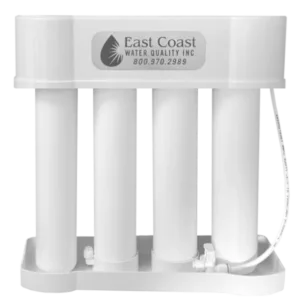
Reverse Osmosis
- Treats drinking and cooking water at one point of use.
- Targets a broad range of dissolved contaminants.
- Can reduce specified PFAS and lead when appropriately rated.
- Reduces TDS, fluoride and excess sodium.
- Uses cartridges plus an RO membrane.
- Best fit when drinking-water purification is the priority.
Many homes can use both.
Whole-home PFAS / lead filtration can treat connected fixtures throughout the house, while reverse osmosis adds a dedicated high-purity drinking-water barrier at the kitchen.
How Often Does a Whole-Home PFAS Filter Need Service?
The Protector PFAS / Lead Series is rated up to 100,000 gallons per cartridge and is typically serviced about once per year for an average household. Actual life depends on water use, feed-water quality and operating conditions.
Track Time and Water Use
Cartridge life is based on both elapsed time and treated-water volume rather than a fixed calendar promise for every household.
Annual Filter Exchange
A technician replaces the cartridge and inspects the housing, seals, bypass and overall operation.
Maintain Coverage
Follow current maintenance and ownership requirements for applicable warranty eligibility.
Why Lead Filtration Can Be a Different Question From PFAS
Portsmouth's 2025 report explains that lead in drinking water can come from service lines and household plumbing materials. That makes lead more property-specific than a city-wide PFAS sample table.
What the City Report Says
Portsmouth missed the routine 2024 Lead and Copper Rule monitoring round. Interim sampling began in May 2026, and the first 20 sites had a 90th-percentile lead result below 0.001 ppm with 0 of 20 sites above the action level.
What That Does Not Tell You
Those results do not measure every Portsmouth home's service line, faucet or plumbing materials. A homeowner with a specific lead concern should use appropriate laboratory testing at the property.
Compare the Water Treatment That Fits Your Goal
Water Problems
Review Portsmouth contaminants, EWG context and the treatment category that fits each concern.
Explore Portsmouth water problems →Reverse Osmosis
Compare whole-home PFAS treatment with point-of-use drinking-water purification.
Explore Portsmouth reverse osmosis →Water Conditioners
Whole-home conditioning is primarily for hardness and selected disinfectant or aesthetic concerns, not a substitute for dedicated PFAS treatment.
Explore Portsmouth water conditioners →Water Quality Report
Read Portsmouth's 2025 PFAS table and lead-and-copper monitoring information.
View the Portsmouth water report →Well Water Treatment
Private-well PFAS or lead concerns require property-specific testing and should not be inferred from municipal-water results.
Explore well-water treatment →Free Water Test
Use the in-home evaluation for hardness and aesthetic conditions, not as a substitute for PFAS or lead laboratory testing.
Schedule a free water test →Portsmouth PFAS Water Filter FAQs
Were PFAS detected in Portsmouth's 2025 Water Quality Report?
The report lists PFOA, PFOS, HFPO-DA, PFHxS, PFNA and PFBS across four samples. Every result is shown below the laboratory quantitation or reporting value listed for that sample, so the report does not provide a quantified concentration above those values.
If Portsmouth's PFAS results were below the listed PQLs, why would I install a PFAS filter?
Some homeowners want an additional treatment barrier even when the latest public-system samples are below listed reporting values. Others want whole-home lead reduction or broader protection throughout connected fixtures. The decision is a household treatment preference, not proof that Portsmouth's water violated a PFAS standard.
Does the Protector PFAS / Lead Series treat the whole house?
Yes. It is installed on the incoming water line so filtered water reaches connected showers, sinks, appliances and drinking-water fixtures.
How much PFAS does the system reduce?
ECWQ lists up to approximately 98% reduction for specified PFAS claims, including PFOA and PFOS, under applicable test conditions. Confirm the exact current certification and model documentation before purchase.
Does the system reduce lead?
ECWQ lists up to 99.62% lead reduction under applicable test conditions. Because lead can be property-specific, a homeowner concerned about the amount at a particular faucet should use appropriate laboratory testing.
How long does a PFAS filter cartridge last?
The Protector PFAS / Lead Series is rated up to 100,000 gallons per cartridge and typically about one year for an average household. Actual service life varies with water use and operating conditions.
Is reverse osmosis better than a whole-home PFAS filter?
They serve different goals. Reverse osmosis provides broad contaminant reduction at a dedicated drinking-water faucet. A whole-home PFAS / lead filter treats water before it reaches connected fixtures throughout the house. Some homeowners use both.
Will a regular water softener remove PFAS?
No. Standard ion-exchange softening is designed primarily for hardness minerals. PFAS treatment should use a system with documented PFAS reduction performance.
Can ECWQ's free water test detect PFAS?
No. ECWQ's free in-home evaluation is for hardness and common aesthetic conditions. PFAS requires appropriate laboratory sampling when you need a property-specific result.
Ask About PFAS & Lead Filtration for Your Portsmouth Home
Compare whole-home Protector PFAS / Lead filtration with reverse osmosis and choose the treatment approach that matches where you want cleaner water and which contaminants you want to address.
Virginia:
Virginia Beach, Norfolk, Chesapeake, Newport News, Hampton, Portsmouth, Suffolk, Williamsburg, Smithfield, Gloucester, Yorktown, Poquoson, Isle of Wight, Carrollton, Seaford, Grafton, Franklin, Emporia, Cape Charles, Courtland, Wakefield, Windsor, Naval Air Station Oceana, Naval Station Norfolk, Langley Air Force Base, Fort Eustis, Fort Monroe
North Carolina:
Raleigh, Durham, Fayetteville, Wilmington, Apex, Burlington, Wake Forest, Garner, Greenville, Jacksonville, Goldsboro, New Bern, Clayton, Kinston, Elizabeth City, Havelock, Hope Mills, Southern Pines, Pinehurst, Laurinburg, Lumberton, Henderson, Tarboro, Morehead City, Washington, Oak Island, Kill Devil Hills, Carolina Beach, Moyock, Shallotte, Williamston, Hampstead, Beaufort, Surf City, Whiteville, Newport, Ahoskie, Edenton, Swansboro, Plymouth, Emerald Isle, Kitty Hawk, Nags Head, Windsor, Sneads Ferry, Hubert, Hertford, Rocky Point, Manteo, Atlantic Beach, Camden, Castle Hayne, Bayboro, Maysville, Riegelwood, Creswell, Vanceboro, Oriental, Roper, Aulander, Rich Square, Currituck, Winton, Corolla, Camp Lejeune
 Hampton Roads VA / Northeast NC
3400 Airline Boulevard, Portsmouth VA 23701
757-966-7600
 Jacksonville NC / Morehead City NC
2582 NC-24, Newport NC 28570
252-777-5151

Wilmington NC / Leland NC
1026 Appleton Way NE #130, Leland, NC 28541
910-807-2300

Raleigh-Durham NC / Garner NC
313F Highway 70 East, Garner, NC 27529
919-238-9900