
Water Conditioners & Water Softeners in Smithfield, VA
Treat water throughout your Smithfield home with a Protector Series whole-home system that combines ion-exchange softening with coconut and catalytic carbon for broader conditioning than a basic softener alone.
*Series, purchaser, maintenance and warranty terms apply.
Is the Protector Series a Water Softener or a Water Conditioner?
The Protector Series is best described as a whole-home water softening conditioner. Ion-exchange resin addresses calcium and magnesium, while carbon media adds whole-home treatment for disinfectant taste and odor concerns.
- Softens water through ion exchange.
- Reduces hardness-related scale and buildup.
- Includes carbon media for chlorine and chloramine treatment.
- Treats water throughout the entire home.
- Protects plumbing and water-using appliances.
- Improves how water feels during bathing, laundry and cleaning.
Why “conditioner” is the better description
A basic softener focuses on hardness minerals. The Protector Series combines softening and carbon filtration, so it conditions more aspects of whole-home water quality than softening alone.
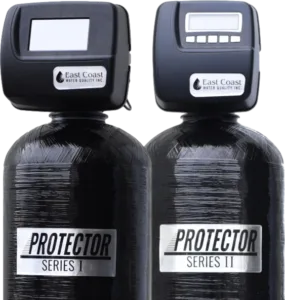
Why a Whole-Home Water Conditioner Can Be Better Than a Basic Water Softener
The Protector Series combines actual ion-exchange softening with carbon treatment in one whole-home system. For Smithfield homeowners, that makes it possible to evaluate hardness treatment and whole-home chlorine taste or odor goals together.
Softening Resin
Ion-exchange resin addresses calcium and magnesium, the primary minerals responsible for hard-water scale.
Coconut Carbon
Activated coconut-shell carbon helps reduce chlorine, taste and odor throughout the home.
Catalytic Carbon
Catalytic carbon is specifically useful for chloramine treatment in municipal water applications.
HighFlo Valve
The 1-inch valve is designed to maintain flow for showers, appliances and multiple fixtures.
Automatic Regeneration
Metered models regenerate based on water use instead of relying only on a fixed schedule.
Whole-Home Coverage
Conditioned water reaches showers, sinks, laundry, dishwashers and other connected fixtures.
Signs Your Smithfield Home May Benefit From Water Conditioning
Smithfield's 2025 Annual Water Quality Report does not publish a municipal hardness value. Hardness should therefore be measured at the property before deciding whether softening is appropriate or sizing a system.
Does Smithfield Need a Water Softener?
The Town's 2025 report does not list hardness, so Smithfield should not be presented as a hard-water market without a property-specific reading. The same report confirms that Smithfield uses groundwater from two deep wells in the Middle Potomac Aquifer and disinfects treated water with sodium hypochlorite.
Hardness Is Not Published
Smithfield's 2025 report does not provide a hardness result. Measure hardness at the home before choosing or sizing a softener.
Whole-Home Carbon
Smithfield uses sodium hypochlorite for disinfection. The Protector Series includes carbon media that can help with chlorine taste and odor throughout the home.
Property-Specific Goals
Plumbing, household preferences, water use and the hardness measured at the property all affect whether a whole-home conditioner makes sense.
Why ECWQ calls it a water conditioner
The system still performs true ion-exchange softening when hardness treatment is needed, but its carbon media broadens the job beyond what a conventional softener alone is designed to do.
How the Protector Series Conditions Water Throughout Your Home
The system combines ion exchange, carbon filtration and automatic regeneration so treated water is available throughout the home.
Water Enters the System
Incoming household water passes through the Protector Series media tank.
Hardness Is Exchanged
Resin beads exchange calcium and magnesium ions for sodium ions, producing softened water.
Carbon Treats Disinfectants
Coconut and catalytic carbon help reduce chlorine, chloramine, taste and odor.
The System Regenerates
The valve refreshes the resin with brine so the system can continue softening water.
Conditioned whole-home water is not the same as reverse-osmosis drinking water.
Ion exchange can add sodium while removing hardness minerals. Many homeowners pair the conditioner with reverse osmosis to reduce sodium and dissolved contaminants at the drinking faucet.
Compare Smithfield Whole-Home Water Conditioner Options
All three Protector Series models combine softening resin with coconut and catalytic carbon. The main differences are valve type, capacity, salt efficiency and warranty.
Premium ModelProtector Series I
Largest capacity, highest salt efficiency and touchscreen metered control.
- Touchscreen metered valve
- 10 × 54 media tank
- 18 × 33 brine tank
- 1 cubic foot softening resin
- ½ cubic foot carbon blend
- Average salt refill: 6–8 months
- Lifetime parts warranty
- 1-year labor warranty
Best-Selling BalanceProtector Series II
Metered performance with lifetime parts coverage and a smaller media capacity than Series I.
- Metered valve
- 10 × 44 media tank
- 18 × 33 brine tank
- ¾ cubic foot softening resin
- ½ cubic foot carbon blend
- Average salt refill: 4–6 months
- Lifetime parts warranty
- 1-year labor warranty
Value ModelProtector Series III
Day-based regeneration with the same softening and carbon-media concept at a lower entry point.
- Non-metered valve
- 10 × 44 media tank
- 15 × 17 brine tank
- ¾ cubic foot softening resin
- ½ cubic foot carbon blend
- Average salt refill: 2–4 months
- 10-year parts warranty
- 1-year labor warranty
Salt use depends on household water consumption, hardness, system settings and operating conditions. Confirm current specifications and warranty terms before purchase.
Protector Series I vs. Series II vs. Series III
| Feature | Series I | Series II | Series III |
|---|---|---|---|
| Valve type | Touchscreen metered | Metered | Non-metered / day based |
| Media tank | 10 × 54 | 10 × 44 | 10 × 44 |
| Softening resin | 1 cubic foot | ¾ cubic foot | ¾ cubic foot |
| Carbon blend | ½ cubic foot | ½ cubic foot | ½ cubic foot |
| Typical salt efficiency | Highest | High | Standard |
| Average refill estimate | 6–8 months | 4–6 months | 2–4 months |
| Parts warranty | Lifetime | Lifetime | 10 years |
| Labor warranty | 1 year | 1 year | 1 year |
| Best for | Maximum capacity and efficiency | Balanced performance and value | Lower initial investment |
Reduce Scale When Hardness Is Present at Your Smithfield Home
When testing confirms enough calcium and magnesium to create hardness-related scale or spotting, ion-exchange softening reduces the mineral load reaching fixtures, plumbing and water-using appliances.
- Helps protect water heaters from mineral scale.
- Reduces buildup in dishwashers and washing machines.
- Helps keep faucets and showerheads cleaner.
- Supports better flow through plumbing and fixtures.
- Reduces scale in coffee makers and kettles.
Softer-Feeling Water for Skin, Hair, Laundry and Cleaning
Homeowners who choose ion-exchange softening may notice differences in bathing, laundry and cleaning. Results and preferences vary with incoming hardness, household water use and personal preference.
- Soap and shampoo lather more easily.
- Skin may feel less coated after bathing.
- Hair may feel easier to rinse and manage.
- Towels and clothing can feel softer.
- Dishes and glassware show fewer hardness spots.
- Less soap, detergent and cleaning product may be needed.
Basic Water Softener vs. Protector Whole-Home Water Conditioner
Both systems can soften water. The difference is that the Protector Series also includes carbon media designed to improve additional whole-home water qualities.
Basic Water Softener
- Uses ion exchange to remove hardness.
- Requires salt and regeneration.
- Reduces scale and water spotting.
- Does not necessarily include carbon filtration.
- May not address chlorine or chloramine.
Protector Water Conditioner
- Uses ion exchange to soften water.
- Includes coconut-shell activated carbon.
- Includes catalytic carbon for chloramine treatment.
- Addresses scale, taste and odor together.
- Provides broader whole-home treatment.
What Happens During a Smithfield Water Conditioner Installation?
East Coast Water Quality evaluates the water at the home, sizes the system, installs it at the main water line and configures regeneration for the household.
- Evaluate the water and household.
We review the water measured at the home, hardness, water use, plumbing layout and treatment goals. - Choose the right Protector Series model.
Capacity and valve selection are matched to the property. - Install at the main water line.
The conditioner is connected so treated water reaches the home’s fixtures and appliances. - Install the drain, bypass and brine tank.
The system is set up for regeneration and easy service access. - Program and test the valve.
Metered models are configured to household demand. - Explain salt and maintenance.
The homeowner receives instructions for operation, salt refills and service.
How to Maintain a Whole-Home Water Conditioner
The Protector Series operates automatically, but it still needs salt and periodic professional service to maintain performance.
Refill the Brine Tank
Use water-softener salt from common hardware and home-improvement stores. Refill timing depends on model, water use and hardness.
Automatic Regeneration
The valve controls regeneration. Metered models use household water consumption to improve efficiency.
Annual Professional Service
Annual inspection helps verify valve operation, settings, salt use, bypass condition and overall performance.
Protect outdoor equipment from freezing.
Systems installed in exterior sheds, pump houses or other unconditioned spaces need adequate freeze protection during prolonged cold weather.
Compare Whole-Home Conditioning With Other Smithfield Water Solutions
Choose the page that matches the problem you want to solve: hardness and whole-home conditioning, drinking-water filtration, PFAS treatment or private-well concerns.
Smithfield Water Problems
Compare hardness, disinfectants, PFAS, lead and other concerns with the appropriate treatment systems.
View water problems →Smithfield Reverse Osmosis
Explore drinking-water treatment for sodium, dissolved solids, PFAS, lead, fluoride and nitrate.
Explore reverse osmosis →Smithfield PFAS Filters
Compare targeted whole-home PFAS and lead filtration with carbon conditioning and RO.
Compare PFAS filtration →Smithfield Water Report
Read the official city report, water source and testing information.
View the water report →Smithfield Well Water
Explore treatment for iron, sulfur odor, acidity, tannins and property-specific well conditions.
Explore well-water treatment →Smithfield Free Water Test
Schedule a thorough in-home water evaluation for common household water concerns and treatment planning.
Schedule a free test →Smithfield Water Softener & Conditioner FAQs
Is Smithfield water hard?
Smithfield's 2025 Annual Water Quality Report does not publish a hardness value. The most reliable way to answer that question for your house is to measure hardness at the property.
Do I need a water softener in Smithfield?
Not automatically. A water softener is most useful when testing confirms enough calcium and magnesium to cause hardness-related scale, spotting or household comfort concerns.
Is the Protector Series a water softener or a water conditioner?
It is a whole-home water softening conditioner. It uses ion-exchange resin for hardness treatment and also includes coconut and catalytic carbon for broader whole-home treatment.
Does Smithfield use chlorine or chloramine?
Smithfield's 2025 report says the Town doses treated water with sodium hypochlorite for disinfection. It does not identify chloramine as the municipal disinfectant.
Can a whole-home conditioner help with chlorine taste or odor?
The Protector Series includes carbon media designed for whole-home disinfectant taste and odor treatment. Actual performance depends on the exact system, water chemistry, flow rate and maintenance.
Will a normal water softener remove PFAS or lead?
No. A standard water softener should not be presented as PFAS treatment. Lead and PFAS require treatment selected for those specific contaminants and supported by the exact product claims.
What is the difference between a water conditioner and reverse osmosis?
A whole-home conditioner treats water throughout the house for hardness and selected taste or odor goals. Reverse osmosis is point-of-use filtration for highly filtered drinking and cooking water.
How do I know which Protector Series model fits my home?
Model selection depends on hardness measured at the home, household water use, plumbing, desired capacity, valve preference and maintenance expectations.
Does ECWQ’s free water test include laboratory contaminant testing?
No. The free in-home evaluation is useful for common household water conditions and treatment planning, but PFAS, lead, bacteria, arsenic, nitrate and other contaminants that require certified analysis should be tested by an appropriate laboratory.
Explore Whole-Home Water Conditioning for Your Smithfield Home
Schedule a free in-home water evaluation and compare Protector Series I, II and III based on your water, plumbing and whole-home treatment goals.
Virginia:
Virginia Beach, Norfolk, Chesapeake, Newport News, Hampton, Portsmouth, Suffolk, Williamsburg, Smithfield, Gloucester, Yorktown, Poquoson, Isle of Wight, Carrollton, Seaford, Grafton, Franklin, Emporia, Cape Charles, Courtland, Wakefield, Windsor, Naval Air Station Oceana, Naval Station Norfolk, Langley Air Force Base, Fort Eustis, Fort Monroe
North Carolina:
Raleigh, Durham, Fayetteville, Wilmington, Apex, Burlington, Wake Forest, Garner, Greenville, Jacksonville, Goldsboro, New Bern, Clayton, Kinston, Elizabeth City, Havelock, Hope Mills, Southern Pines, Pinehurst, Laurinburg, Lumberton, Henderson, Tarboro, Morehead City, Washington, Oak Island, Kill Devil Hills, Carolina Beach, Moyock, Shallotte, Williamston, Hampstead, Beaufort, Surf City, Whiteville, Newport, Ahoskie, Edenton, Swansboro, Plymouth, Emerald Isle, Kitty Hawk, Nags Head, Windsor, Sneads Ferry, Hubert, Hertford, Rocky Point, Manteo, Atlantic Beach, Camden, Castle Hayne, Bayboro, Maysville, Riegelwood, Creswell, Vanceboro, Oriental, Roper, Aulander, Rich Square, Currituck, Winton, Corolla, Camp Lejeune
 Hampton Roads VA / Northeast NC
3400 Airline Boulevard, Portsmouth VA 23701
757-966-7600
 Jacksonville NC / Morehead City NC
2582 NC-24, Newport NC 28570
252-777-5151

Wilmington NC / Leland NC
1026 Appleton Way NE #130, Leland, NC 28541
910-807-2300

Raleigh-Durham NC / Garner NC
313F Highway 70 East, Garner, NC 27529
919-238-9900